Understanding Tree Traversals — Implementation Deep Dive
Recursive vs iterative approaches, stack-based implementations, and production-ready code for tree traversals.
Recursive vs iterative approaches, stack-based implementations, and production-ready code for tree traversals.
Author
Mr. Oz
Date
Read
8 mins
Level 2
Author
Mr. Oz
Date
Read
8 mins
Share


Now that we understand the library exploration analogy, let's dive into the actual implementation. We'll explore recursive solutions, iterative approaches with stacks, and production-ready patterns.
First, let's define a binary tree node. A node contains three things:
# Python implementation
class TreeNode:
    def __init__(self, val=0, left=None, right=None):
        self.val = val
        self.left = left    # Left child
        self.right = right  # Right child

# Java implementation
class TreeNode {
    int val;
    TreeNode left;
    TreeNode right;

    public TreeNode(int val) {
        this.val = val;
        this.left = null;
        this.right = null;
    }
}

# C++ implementation
struct TreeNode {
    int val;
    TreeNode* left;
    TreeNode* right;

    TreeNode(int x) : val(x), left(nullptr), right(nullptr) {}
};The most elegant approach — recursion naturally matches the tree structure. Each call processes a subtree.
def inorder_recursive(root):
    """Inorder traversal using recursion"""
    result = []

    def traverse(node):
        # Base case: empty node
        if not node:
            return

        # Step 1: Traverse left subtree
        traverse(node.left)

        # Step 2: Visit current node
        result.append(node.val)

        # Step 3: Traverse right subtree
        traverse(node.right)

    traverse(root)
    return result

# Time Complexity: O(n) - visit each node once
# Space Complexity: O(h) - recursion stack depth, where h is tree height
Key insight: The call stack naturally remembers where to return after processing subtrees.
Visit the root first, then children. Perfect for creating a copy of the tree.
def preorder_recursive(root):
    """Preorder traversal using recursion"""
    result = []

    def traverse(node):
        if not node:
            return

        # Step 1: Visit current node FIRST
        result.append(node.val)

        # Step 2: Traverse left subtree
        traverse(node.left)

        # Step 3: Traverse right subtree
        traverse(node.right)

    traverse(root)
return resultVisit children first, then root. Essential for deleting trees bottom-up.
def postorder_recursive(root):
    """Postorder traversal using recursion"""
    result = []

    def traverse(node):
        if not node:
            return

        # Step 1: Traverse left subtree
        traverse(node.left)

        # Step 2: Traverse right subtree
        traverse(node.right)

        # Step 3: Visit current node LAST
        result.append(node.val)

    traverse(root)
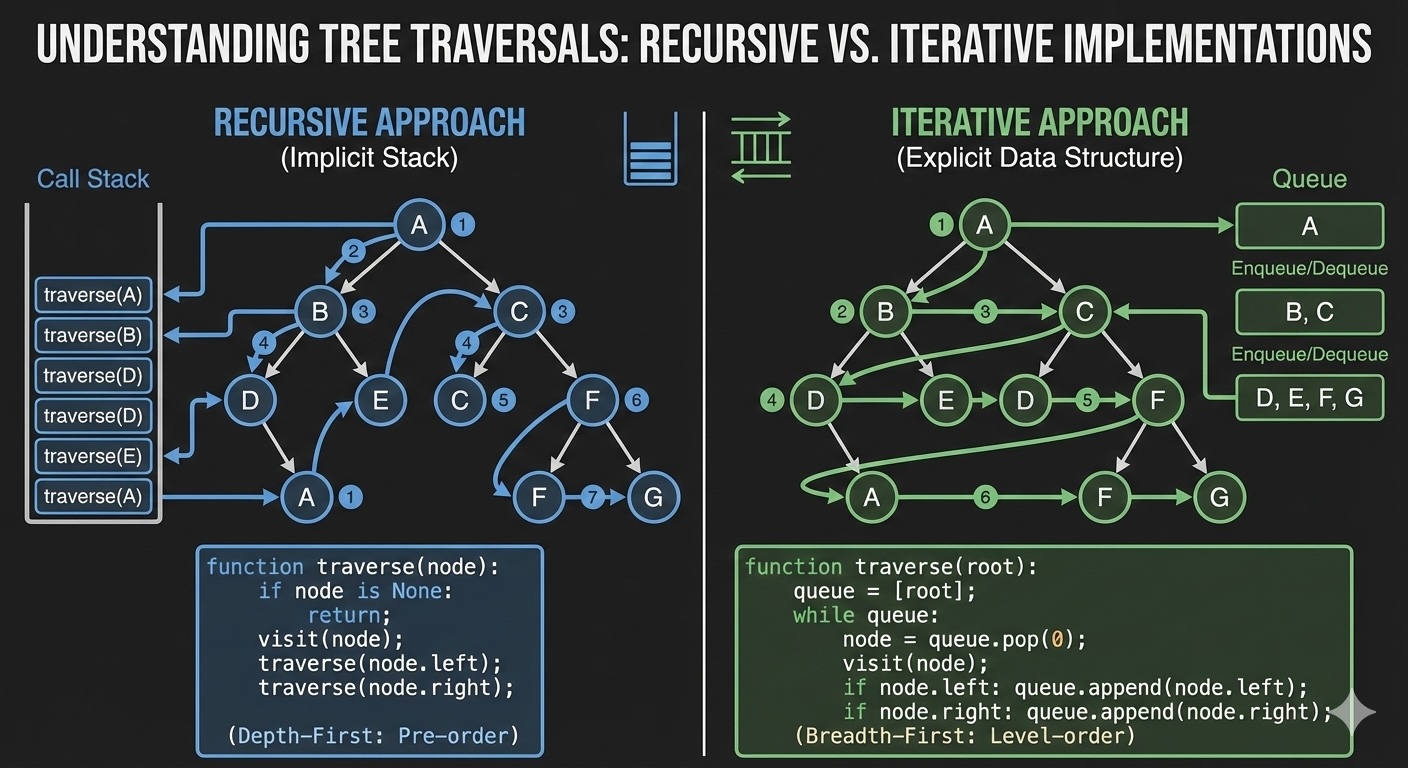
return resultRecursion is elegant but can cause stack overflow. Let's implement iteratively using an explicit stack.
def inorder_iterative(root):
    """Inorder traversal using explicit stack"""
    result = []
    stack = []
    current = root

    while current or stack:
        # Go as far left as possible
        while current:
            stack.append(current)
            current = current.left

        # Pop and visit the node
        current = stack.pop()
        result.append(current.val)

        # Move to right subtree
        current = current.right

    return result

# Time Complexity: O(n) - each node pushed/popped once
# Space Complexity: O(h) - stack depth equals tree height
Key insight: The stack simulates the call stack from the recursive version.
For preorder, we push right child first (so left is processed first due to LIFO).
def preorder_iterative(root):
    """Preorder traversal using explicit stack"""
    if not root:
        return []

    result = []
    stack = [root]

    while stack:
        node = stack.pop()
        result.append(node.val)

        # Push right FIRST, then left (so left is processed first)
        if node.right:
            stack.append(node.right)
        if node.left:
            stack.append(node.left)

return resultUnlike the depth-first traversals above, this visits nodes level by level using a queue.
from collections import deque

def level_order(root):
    """Level-order traversal (BFS) using queue"""
    if not root:
        return []

    result = []
    queue = deque([root])

    while queue:
        node = queue.popleft()
        result.append(node.val)

        if node.left:
            queue.append(node.left)
        if node.right:
            queue.append(node.right)

    return result

# Time Complexity: O(n) - visit each node once
# Space Complexity: O(w) - where w is max width of tree
Use case: Finding the shortest path, level-by-level processing, or when you need to process nodes in order of depth.
if node: or if node is not None:
| Traversal | Time | Space (Recursive) | Space (Iterative) |
|---|---|---|---|
| Inorder | O(n) | O(h) | O(h) |
| Preorder | O(n) | O(h) | O(h) |
| Postorder | O(n) | O(h) | O(h) |
| Level Order | O(n) | N/A | O(w) |
Where h = tree height, w = max tree width (worst case O(n) for all)
For balanced trees, h = O(log n)
Ready for the deep dive?