Understanding Tree Traversals: The Library Explorer
Discover how tree traversals organize data through an engaging library exploration analogy. Learn why the order you visit nodes matters more than you think.
Discover how tree traversals organize data through an engaging library exploration analogy. Learn why the order you visit nodes matters more than you think.
Author
Mr. Oz
Date
Read
5 mins
Level 1

Author
Mr. Oz
Date
Read
5 mins
Share


Imagine you're exploring a massive library with books organized in a tree-like structure. Each floor has sections, each section has shelves, and each shelf has books. How would you visit every book systematically?
This is exactly what tree traversals do in computer science — they define how to systematically visit every node in a tree structure.
Picture a simple library tree:
How many ways can you explore this library? Let's count the main strategies!
The Method: Always explore the left side first, then visit the current location, then explore the right side.
Why it's special: For sorted data (like a Binary Search Tree), this visits items in sorted order!
It's like reading a book from left to right — you naturally encounter things in order.
The Method: Visit the current location first, then explore left, then explore right.
Why it's special: You always know the root/parent before the children. Great for creating copies of trees!
It's like being a tour guide — you announce where you are before exploring deeper.
The Method: Explore left, explore right, then visit the current location last.
Why it's special: You process children before their parent. Perfect for deleting trees (delete leaves first!).
It's like cleaning a house — you clean the rooms before cleaning the hallway that connects them.
Think of it as deciding when to "stamp your library card" at each location:
The magic is that all three visit every node exactly once — just in different orders!
You might wonder: "Does the order really matter as long as I visit everything?"
Yes! The order determines:
Each traversal strategy has its strengths:
The key insight: Tree traversals give you the power to decide WHEN to process each node relative to its children. Choose the strategy that matches what you need to accomplish!
Ready to go deeper?
Level 1
Learn the fundamentals of tree traversals through an engaging library exploration analogy.
Author
Mr. Oz
Duration
5 mins
Level 2
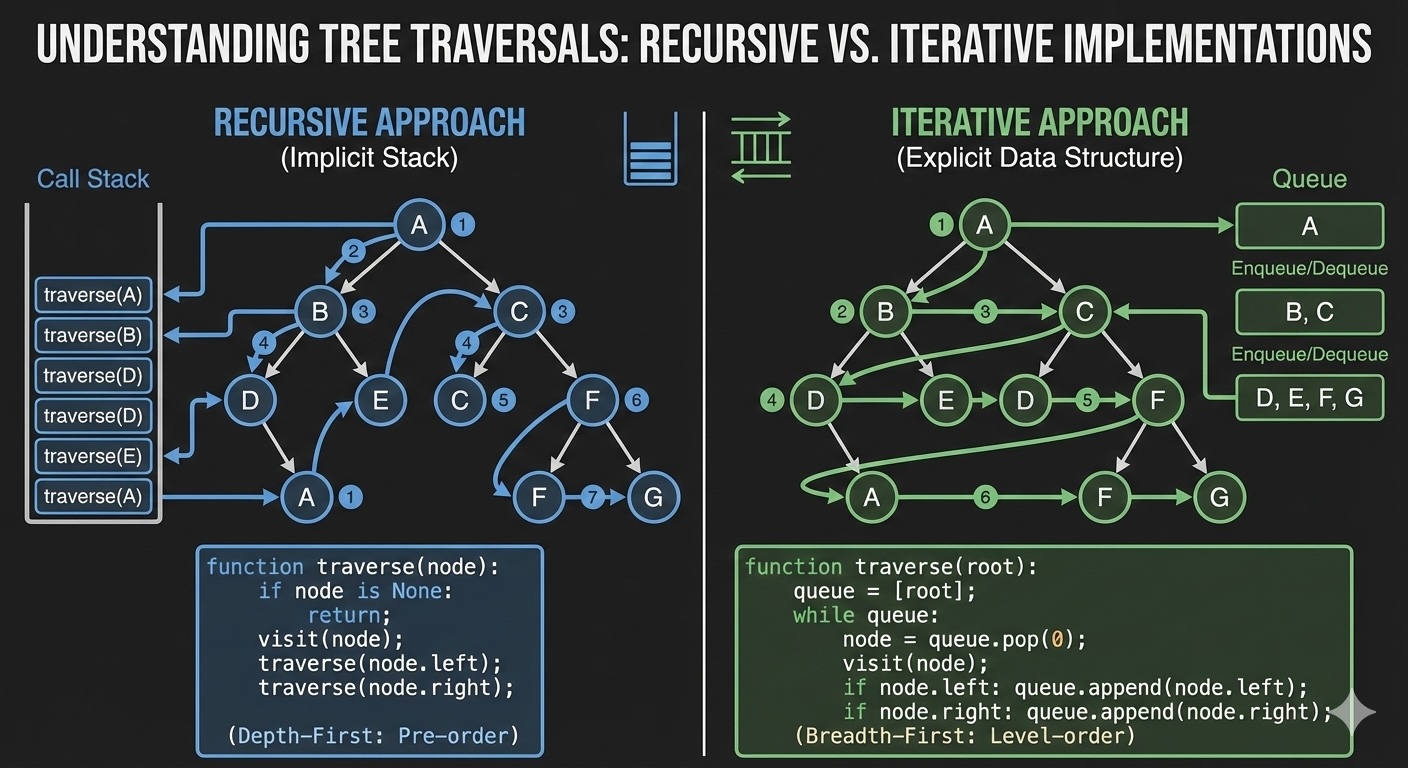
Implementation details, recursive vs iterative approaches, and practical code examples.
Author
Mr. Oz
Duration
8 mins
Level 3

Memory layout, cache performance, recursion stack overhead, and optimization techniques.
Author
Mr. Oz
Duration
12 mins