Understanding Tree Algorithms: The Family Gathering
Discover how tree algorithms work through an engaging family gathering analogy. Learn to find common ancestors and understand relationships in tree structures.
Discover how tree algorithms work through an engaging family gathering analogy. Learn to find common ancestors and understand relationships in tree structures.
Author
Mr. Oz
Date
Read
5 mins
Level 1
Author
Mr. Oz
Date
Read
5 mins
Share


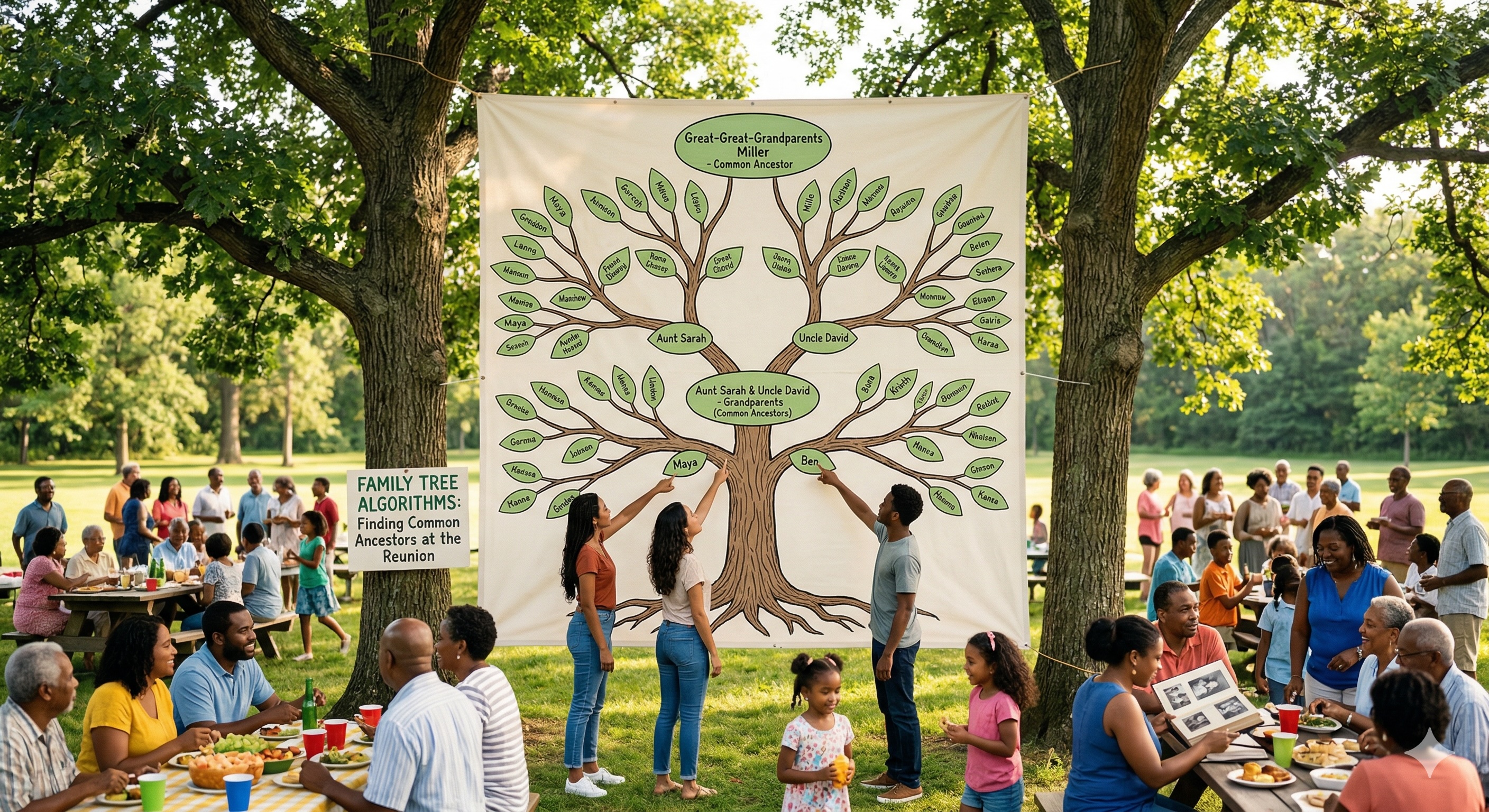
Imagine you're at a grand family gathering with relatives spread across multiple generations. Someone asks: "What's the closest ancestor that both Alice and Bob share?"
This is exactly what tree algorithms help us do in computer science — they help us find common ancestors, understand hierarchies, and navigate family trees of data.
Picture a family tree where each person has two parents:
If we want to find the closest common ancestor of Alice and Bob:
The "lowest" means closest to the descendants:
How do we find this ancestor efficiently?
Here's the magic: if we find Alice in the left subtree and Bob in the right subtree of the same person, that person IS the lowest common ancestor!
Why?
Simple and elegant. Uses call stack. Can overflow for very deep trees.
More complex. Avoids stack overflow. Requires parent pointers or explicit stack.
Understanding the Lowest Common Ancestor problem opens the door to many tree algorithms:
Ready to dive into the implementation details? Let's go to Level 2!