Understanding Sliding Window — Implementation Deep Dive
Two pointer techniques, fixed vs variable-size windows, and production-ready patterns for common problems.
Two pointer techniques, fixed vs variable-size windows, and production-ready patterns for common problems.
Author
Mr. Oz
Date
Read
8 mins
Level 2
Author
Mr. Oz
Date
Read
8 mins
Share


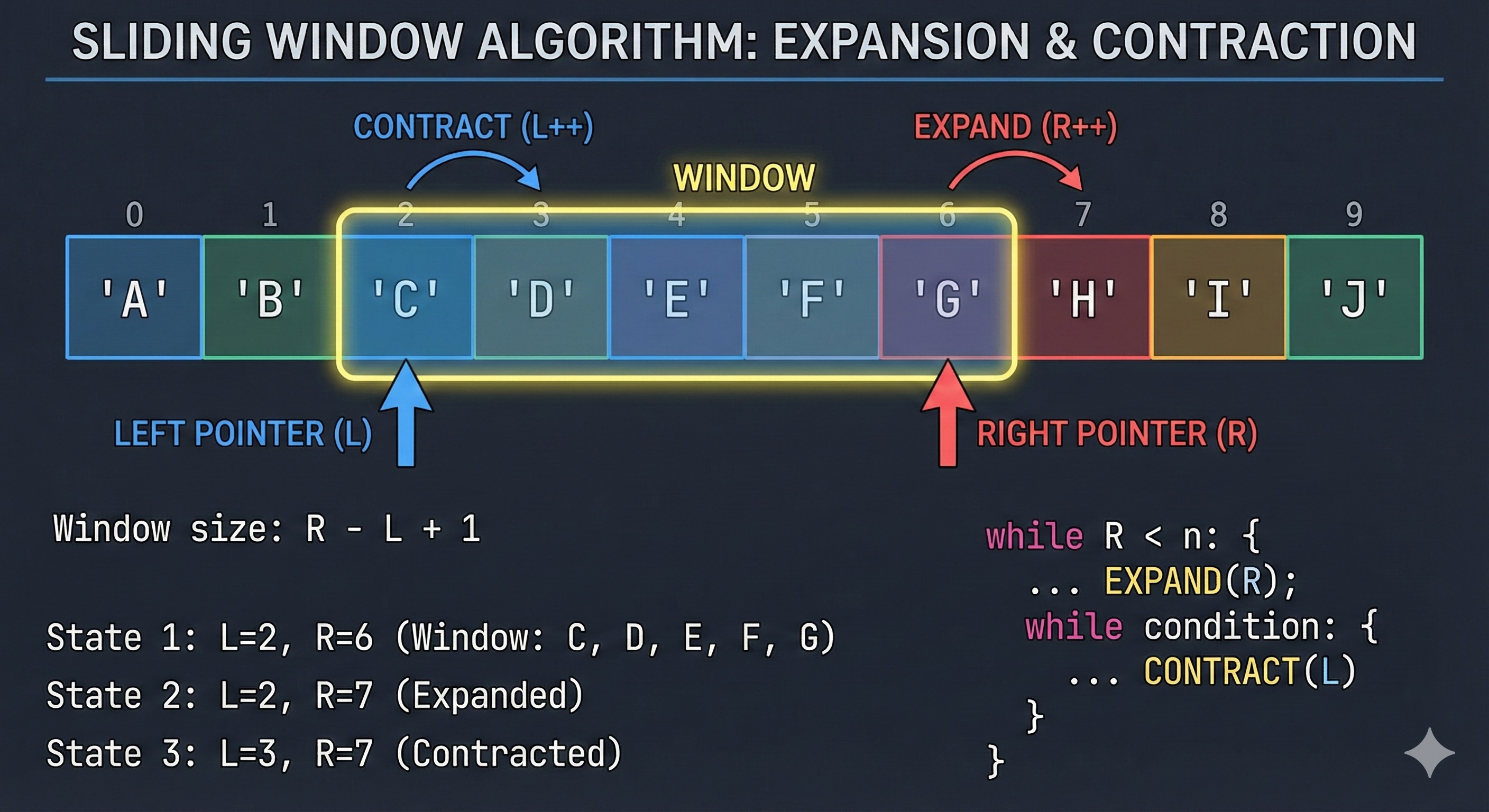
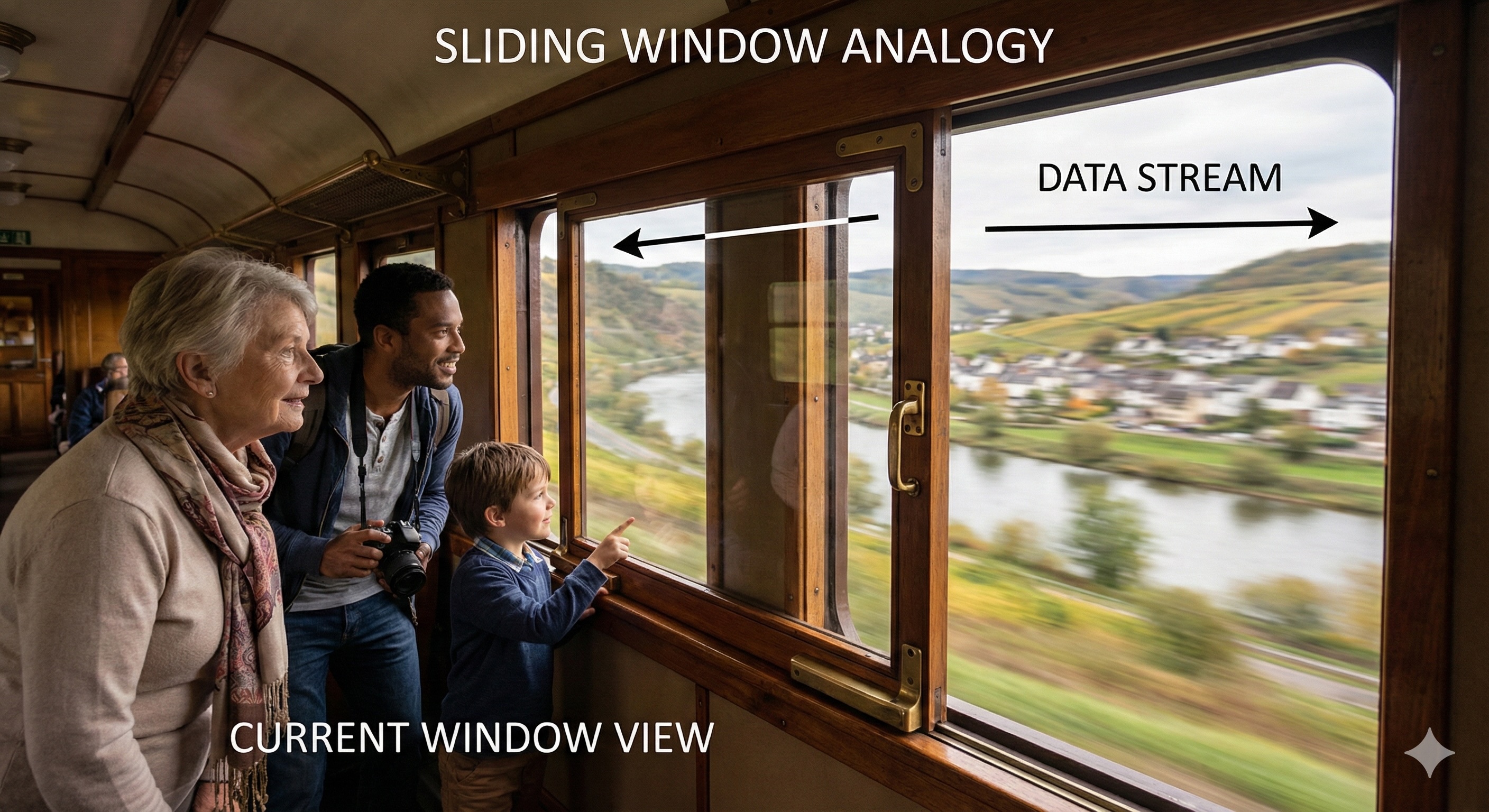
Now that we understand the train window analogy, let's dive into the actual implementation. We'll explore fixed vs variable-size windows, two pointer techniques, and how to handle edge cases like a pro.
At the heart of every sliding window solution are two pointers:
# Basic structure
left = 0
for right in range(len(data)):
    # Expand window by including data[right]
    # Process current window
# Shrink window from left if neededWhen the window size is known in advance, the pattern is straightforward:
# Example: Maximum sum of k consecutive elements
def max_sum_subarray(nums, k):
    if len(nums) < k:
        return 0

    # Initialize first window
    window_sum = sum(nums[:k])
    max_sum = window_sum

    # Slide the window
    for i in range(k, len(nums)):
        # Add new element, remove old element
        window_sum += nums[i] - nums[i - k]
        max_sum = max(max_sum, window_sum)

    return max_sum
Key insight: We don't recalculate the sum from scratch — we just add the new element and subtract the element we're leaving behind.
When the window grows and shrinks based on conditions, we need more careful management:
# Example: Longest substring without repeating characters
def longest_unique_substring(s):
    char_map = {}
    left = 0
    max_len = 0

    for right, char in enumerate(s):
        # If char is in current window, shrink from left
        if char in char_map and char_map[char] >= left:
            left = char_map[char] + 1

        # Update character position
        char_map[char] = right

        # Update maximum length
        max_len = max(max_len, right - left + 1)

    return max_len
Key insight: The window grows with the right pointer but only shrinks when we encounter a condition violation (like a duplicate character).
Look for these keywords and patterns:
| Operation | Time Complexity | Notes |
|---|---|---|
| Initialize window | O(k) | k = window size |
| Slide window (fixed size) | O(1) | Add new, remove old |
| Slide window (variable size) | O(1) amortized | Each element visited twice |
| Hash map lookup | O(1) average | For tracking characters/sums |
❌ Off-by-one errors
Forgetting that window size is right - left + 1, not right - left
✓ Always verify with small examples (arrays of length 1, 2, 3)
❌ Not checking if element is in current window
When shrinking, verify the element is actually within [left, right] before moving left
✓ Use map[char] >= left check before shrinking
❌ Forgetting edge cases
Empty input, single element, window size larger than array
✓ Always handle: empty array, k > len(array), k <= 0
window_start and window_end are clearer than i and jFor advanced sliding window problems like "maximum in each sliding window":
from collections import deque

def max_sliding_window(nums, k):
    result = []
    window = deque()  # stores indices, values are in decreasing order

    for i, num in enumerate(nums):
        # Remove indices outside current window
        while window and window[0] <= i - k:
            window.popleft()

        # Remove smaller elements (they can't be maximum)
        while window and nums[window[-1]] < num:
            window.pop()

        window.append(i)

        # Add maximum to result when window is fully formed
        if i >= k - 1:
            result.append(nums[window[0]])

    return result
Key insight: The deque maintains indices in decreasing order of their values, so the maximum is always at the front.
Python
Use collections.defaultdict for frequency maps. Use enumerate() for index-value pairs.
Java
Use HashMap<K, V> for character/index tracking. Use ArrayDeque for deque operations.
C++
Use unordered_map for O(1) lookups. Use deque from <deque> for queue operations.
Ready to go deeper?
Level 1
Learn the fundamentals of sliding window through an engaging train journey analogy.
Author
Mr. Oz
Duration
5 mins
Level 2
Implementation details, fixed vs variable-size windows, common patterns, and code examples.
Author
Mr. Oz
Duration
8 mins
Level 3
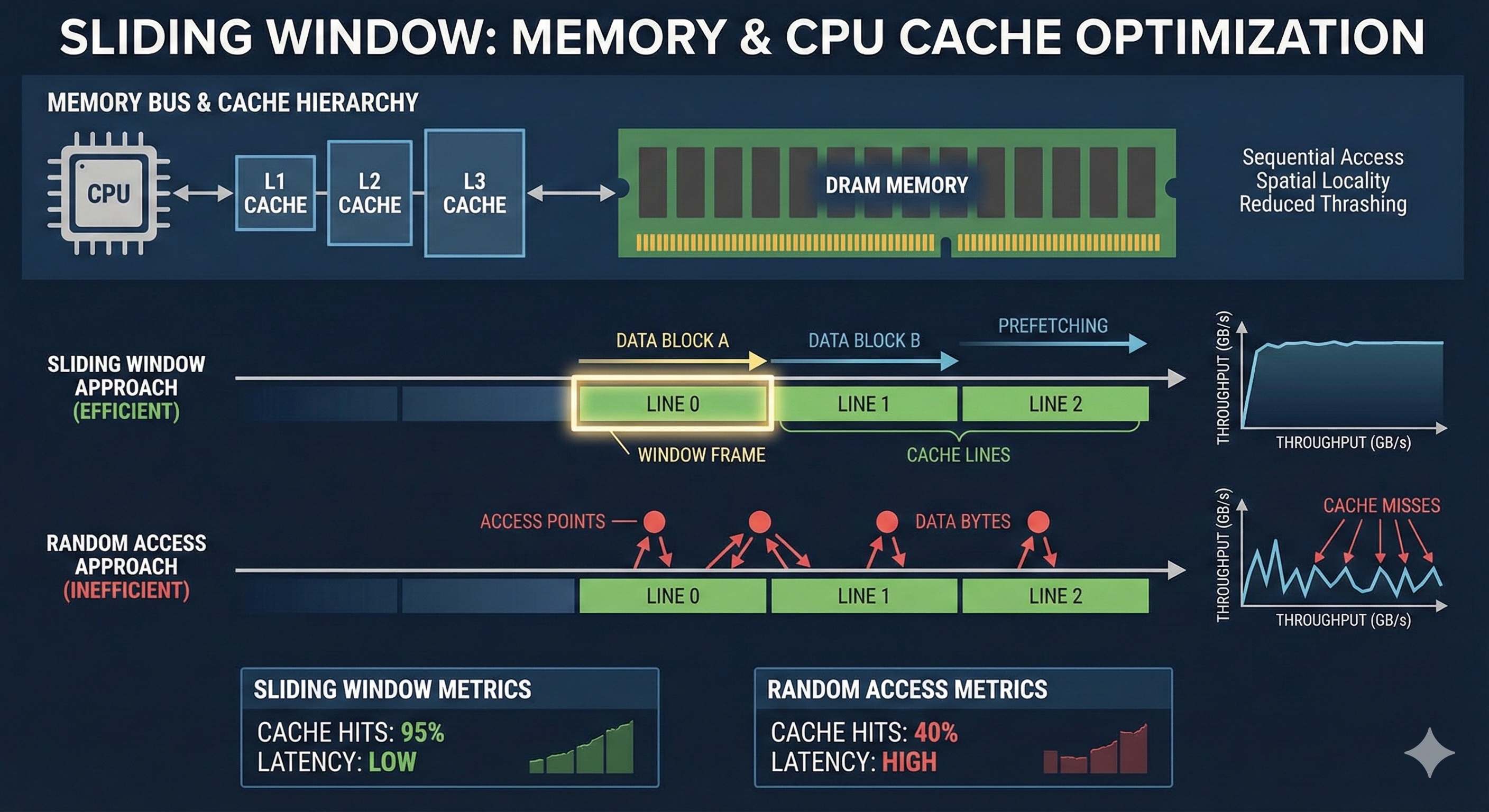
Advanced optimization, memory patterns, and when to use sliding window vs. alternatives.
Author
Mr. Oz
Duration
12 mins