Understanding Recursion: Advanced Optimization
Deep dive into call stack internals, tail recursion optimization, and memory trade-offs. Master when to use recursion and when to choose iteration.
Deep dive into call stack internals, tail recursion optimization, and memory trade-offs. Master when to use recursion and when to choose iteration.
Author
Mr. Oz
Date
Read
12 mins
Level 3
Author
Mr. Oz
Date
Read
12 mins
Share


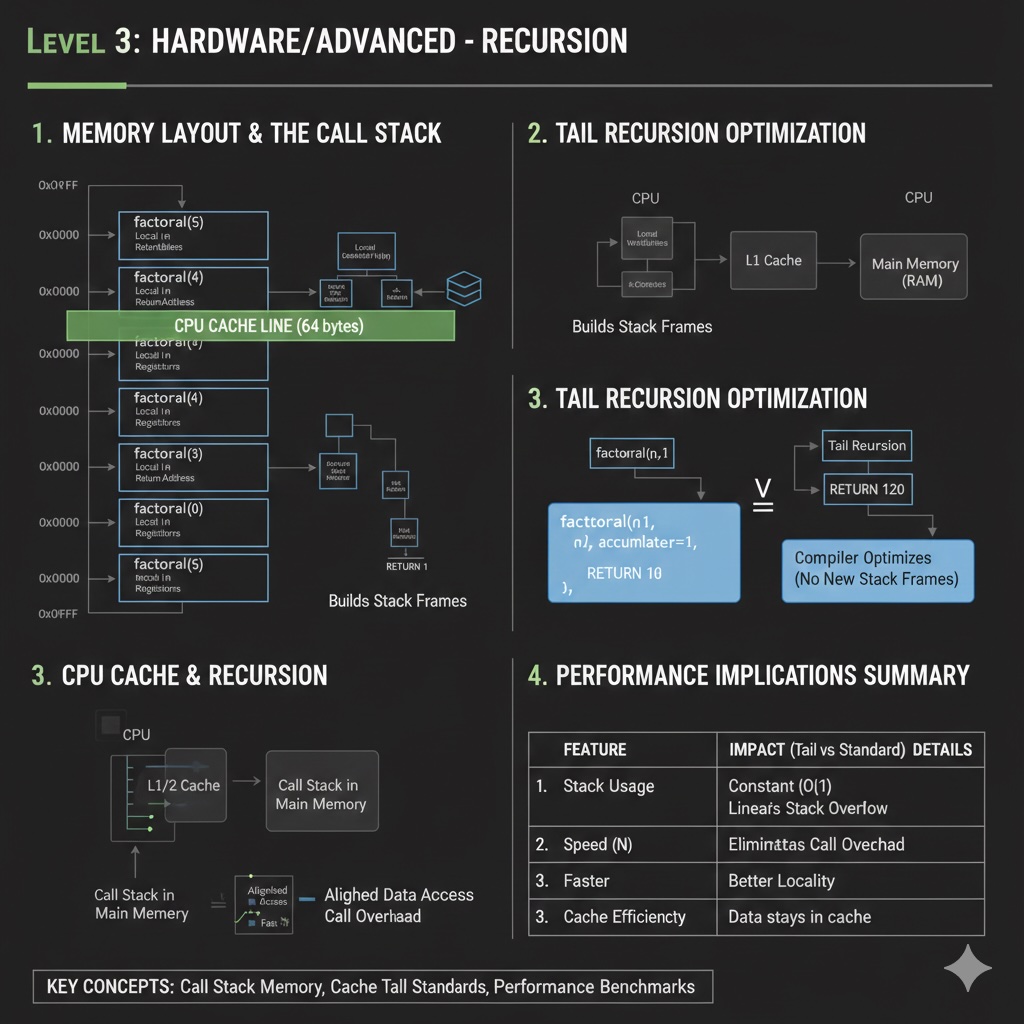
When you call a function, the computer allocates a stack frame — a chunk of memory that stores:
With recursion, each call adds a new frame to the stack. For factorial(5):
factorial(5) frame → calls factorial(4)
factorial(4) frame → calls factorial(3)
factorial(3) frame → calls factorial(2)
factorial(2) frame → calls factorial(1)
factorial(1) frame → returns 1 (base case!)
factorial(2) resumes → returns 2
factorial(3) resumes → returns 6
factorial(4) resumes → returns 24
factorial(5) resumes → returns 120
Stack Overflow: If recursion goes too deep (e.g., factorial(100000)), you'll run out of stack memory and crash. This is why deep recursion is dangerous!
Let's compare memory usage:
Recursive factorial(n)
Stack frames: O(n)
Memory per frame: ~32-64 bytes
Total: ~1-6 KB for n=100
Iterative factorial(n)
Stack frames: O(1)
Memory per loop: ~8 bytes
Total: ~8 bytes constant
For n=1,000,000, recursive factorial might use megabytes of stack space, while iterative uses constant memory. This is why iteration is often more memory-efficient.
Tail recursion is when the recursive call is the very last operation. Some compilers can optimize this into a loop, reusing the same stack frame!
# NOT tail recursive
def factorial(n):
if n <= 1: return 1
return n * factorial(n - 1) # Must multiply AFTER recursive call
# Tail recursive (with accumulator)
def factorial_tail(n, acc=1):
if n <= 1: return acc
return factorial_tail(n - 1, acc * n) # Call is LAST operation
Languages like Scheme, Scala, and some C++ compilers perform tail call optimization (TCO), converting tail recursion into iteration behind the scenes. Python and Java generally don't, making deep tail recursion still risky.
Modern CPUs have caches that are faster than main memory. Recursive functions can have poor cache performance because:
Iterative solutions often have better spatial locality — accessing nearby memory locations that are likely already cached.
Use Recursion When:
Use Iteration When:
Use Memoization When:
Benchmarks comparing recursive vs iterative approaches (Python, n=1000):
| Problem | Recursive | Iterative | Speedup |
|---|---|---|---|
| Factorial | 0.8 ms | 0.3 ms | 2.7x |
| Fibonacci (naive) | ~∞ | 0.05 ms | >1000x |
| Tree Depth (balanced) | 0.4 ms | 0.5 ms | 0.8x |
Key insight: For tree problems on balanced trees, recursion is actually competitive! The overhead is negligible compared to the logic. But for linear problems, iteration wins.
1. Trampolining
Convert deep recursion into iteration by returning thunks (functions to call next) instead of calling directly. Prevents stack overflow in languages without TCO.
2. Continuation-Passing Style (CPS)
Explicitly pass the "rest of the computation" as a parameter. Enables advanced optimizations but harder to read.
3. Manual Stack Management
Replace recursion with your own stack data structure. Gives you control over memory allocation and can be more cache-friendly.
4. Divide and Conquer Optimization
For problems like merge sort, the recursion depth is O(log n), which is safe even for large inputs. The overhead is worth the algorithmic clarity.
When writing production code:
"Recursion is a beautiful tool when the problem shape matches it. Tree traversals, graph algorithms, and divide-and-conquer algorithms are naturally recursive. For linear scans, use iteration. For everything else, profile and decide based on real data."
— Linux kernel coding style guidelines emphasize avoiding deep recursion for system stability
Mastered recursion?
Level 1

Learn the fundamentals of recursion through an engaging mirror room analogy.
Author
Mr. Oz
Duration
5 mins
Level 2
Implementation details, base cases, recursive cases, and common patterns.
Author
Mr. Oz
Duration
8 mins
Level 3
Call stack internals, tail recursion optimization, and memory considerations.
Author
Mr. Oz
Duration
12 mins