Understanding Linked Lists — Implementation Deep Dive
Pointer manipulation, traversal algorithms, insertion and deletion operations for production-ready code.
Pointer manipulation, traversal algorithms, insertion and deletion operations for production-ready code.
Author
Mr. Oz
Date
Read
8 mins
Level 2
Author
Mr. Oz
Date
Read
8 mins
Share


Now that we understand the treasure hunt analogy, let's dive into the actual implementation. We'll explore pointer manipulation, common operations, and how to handle edge cases like a pro.
Every linked list is built from nodes. A node contains two things:
# Python implementation
class Node:
    def __init__(self, value):
        self.value = value  # The data
        self.next = None    # Pointer to next node (initially None)

# Java implementation
class Node {
    int value;
    Node next;

    public Node(int value) {
        this.value = value;
        this.next = null;
    }
}

# C++ implementation
struct Node {
    int value;
    Node* next;

    Node(int val) : value(val), next(nullptr) {}
};The most fundamental operation — visiting each node in order. This is how we "follow the clues" in our treasure hunt.
def traverse(head):
    """Visit each node and print its value"""
    current = head  # Start at the beginning

    while current is not None:  # Continue until we reach null
        print(current.value)  # Do something with the value
        current = current.next  # Move to the next node

# Time Complexity: O(n) - we visit each node once
# Space Complexity: O(1) - we only use one pointer variable
Key insight: We never move backward — only forward. The "current" pointer advances one step at a time.
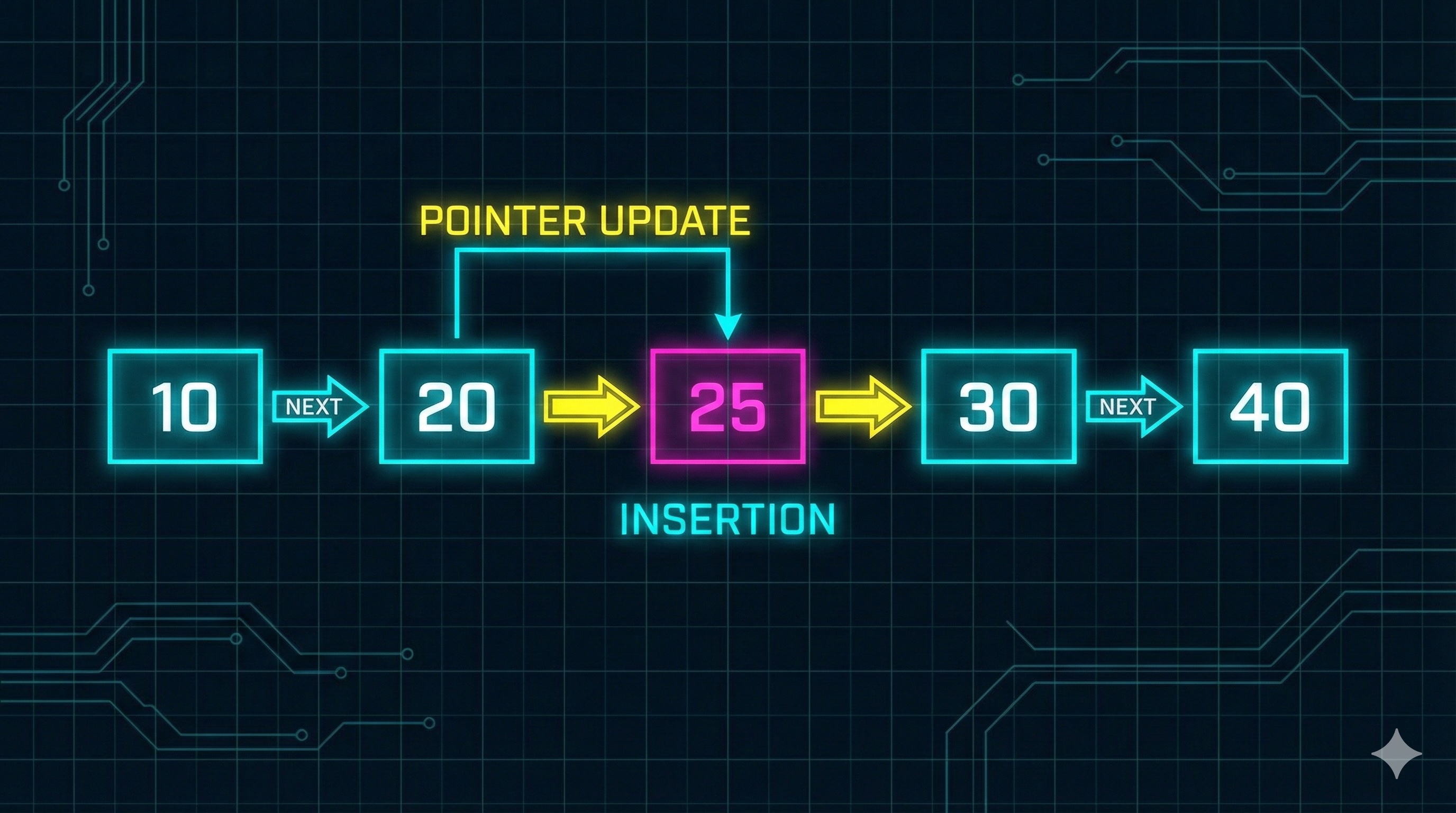
Adding a new node at the start of the list is O(1) — constant time!
def insert_at_beginning(head, value):
    """Insert a new node at the start of the list"""
    new_node = Node(value)  # Create the new node

    # Point new node's next to current head
    new_node.next = head

    # Return new node as the new head
    return new_node

# Time Complexity: O(1) - just a few pointer changes
# Space Complexity: O(1) - we only create one new node
Visual: [NEW] → [old_head] → ...
Adding at the end requires traversing to find the last node, so it's O(n).
def insert_at_end(head, value):
    """Insert a new node at the end of the list"""
    new_node = Node(value)

    # Edge case: empty list
    if head is None:
        return new_node

    # Traverse to find the last node
    current = head
    while current.next is not None:
        current = current.next

    # Attach new node
    current.next = new_node
    return head

# Time Complexity: O(n) - we must traverse to the end
# Space Complexity: O(1) - we only create one new node
Tip: If you frequently insert at the end, maintain a "tail" pointer for O(1) operations.
Deleting a node requires finding the node before it, so we can redirect its pointer.
def delete_node(head, value):
    """Delete the first node with the given value"""
    # Edge case: empty list
    if head is None:
        return None

    # Edge case: deleting the head
    if head.value == value:
        return head.next

    # Find the node before the one we want to delete
    current = head
    while current.next is not None and current.next.value != value:
        current = current.next

    # If we found the node, skip over it
    if current.next is not None:
        current.next = current.next.next

    return head

# Time Complexity: O(n) - worst case, we traverse the whole list
# Space Complexity: O(1) - we only use pointer variables
Key insight: We never actually "delete" memory — we just stop referencing it. Garbage collection handles the rest (in managed languages).
One of the most elegant techniques in linked list problems is the dummy node.
Instead of worrying about which node is the "head" of our result, we create a placeholder node at the start. This eliminates special cases for the first node.
# Using dummy node to build a new list
dummy = Node(0)  # Placeholder
current = dummy

# Build the list...
current.next = Node(1)
current = current.next
current.next = Node(2)

# Return the actual result (skip the dummy)
return dummy.next
Why this matters: Without a dummy node, you'd need conditional logic to handle the first node differently. The dummy node eliminates this edge case, making your code cleaner and less bug-prone.
head = head.next without saving the old head
if node and node.next:
| Operation | Time | Space |
|---|---|---|
| Access by index | O(n) | O(1) |
| Insert at beginning | O(1) | O(1) |
| Insert at end | O(n)* | O(1) |
| Insert at middle | O(n) | O(1) |
| Delete | O(n) | O(1) |
| Search | O(n) | O(1) |
*O(1) if you maintain a tail pointer
Ready for the deep dive?