What is an Array?
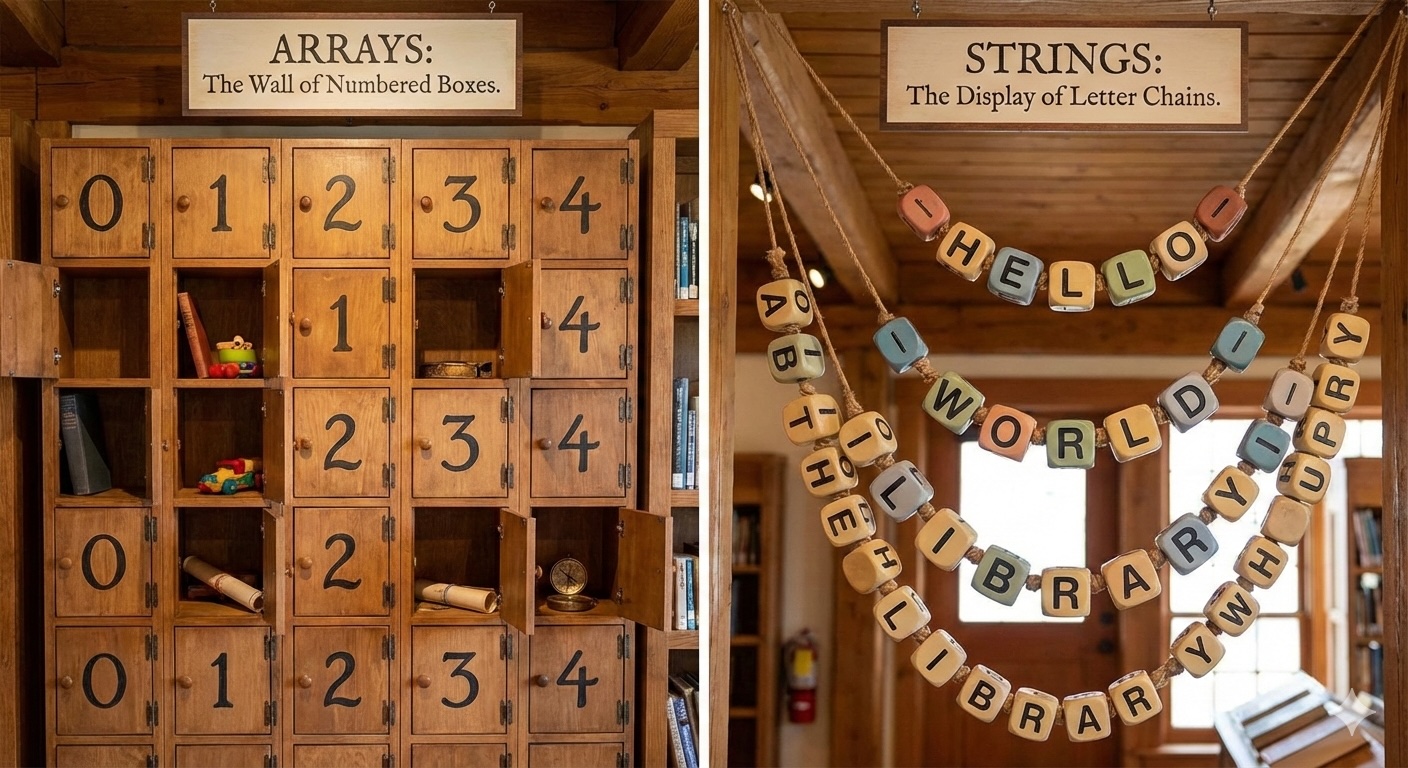
Think of an array like a row of numbered lockers in a school hallway. Each locker has a unique number starting from zero, and inside each locker, you can store anything—numbers, words, or even other collections of items.
The key feature of these lockers is that they're organized and predictable. If you want locker #5, you know exactly where to find it. You don't need to search through other lockers first. This direct access makes arrays very efficient when you know exactly what you're looking for.
What is a String?
Now imagine a string of letters, like the letters on a child's alphabet toy that snap together to form words. Each letter is connected to the next, forming a sequence that reads as "HELLO" or "WORLD."
A string is like one of those alphabet chains, but in your computer's memory. Each character connects to the next, forming words, sentences, and paragraphs. Unlike the numbered lockers, you can't just jump to letter #10 without visiting all the letters before it—you have to follow the chain.
The Key Differences
So what's the real difference between these two storage systems?
- Arrays are flexible containers. Each position can hold different types of things—numbers, strings, objects, or even other arrays.
- Strings are specialized. They only hold characters, and those characters always form text. You can't put a number directly into a string without converting it to text first.
- Arrays let you jump directly to any position. If you want item #100, you go straight there.
- Strings require you to traverse character by character. To find the 100th character, you must pass through the first 99.
Why Does This Matter?
Understanding this distinction helps you make better decisions when writing code. If you need to store a list of student ages, an array is perfect—each position holds a number, and you can access any age directly. If you're working with text, like a sentence or a paragraph, a string is the natural choice.
But here's the fascinating part: under the hood, strings are often implemented as arrays of characters. Your computer sees "HELLO" as an array ['H', 'E', 'L', 'L', 'O'], but it treats it specially because it knows this array represents text, not just a random collection of items.
Trade-offs and Considerations
Arrays offer flexibility and direct access, making them ideal for collections of items where you know the position. Strings provide structure and meaning when working with text. Neither is inherently better—they serve different purposes.
Sometimes you'll convert between them. You might split a string into an array of words to process each word individually, then join them back into a string when you're done. This back-and-forth transformation is common in programming.
The Journey Continues
We've just scratched the surface of how arrays and strings work. In the real world, strings aren't just simple chains of letters—they involve encoding, Unicode characters, memory management, and performance optimizations that can make or break your application.
Ready to dive deeper? In Level 2, we'll explore how these structures are implemented in code, and you'll see firsthand why understanding the difference matters when writing efficient software.