Understanding Tree Properties: The Balanced Architect

Discover why tree balance matters through an architectural analogy. Learn how unbalanced structures lead to inefficiency.

Author

Mr. Oz

Date

Read

5 mins

Level 1
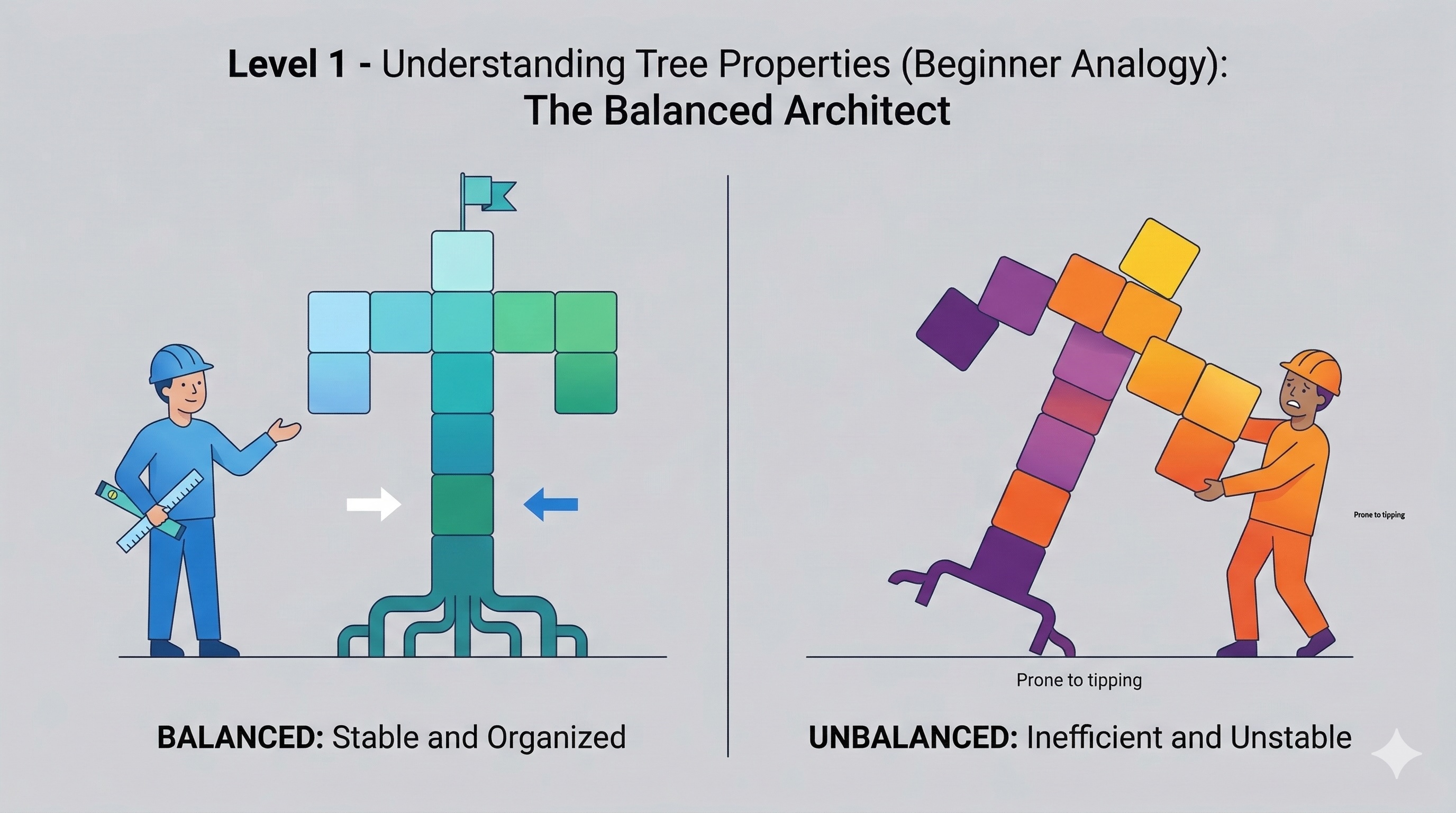
A balanced architectural structure with symmetrical support beams, representing a balanced binary tree

Author

Mr. Oz

Date

Read

5 mins

Share

Imagine you're an architect designing a tower. You have two choices: build it with perfectly balanced support on each floor, or let one side grow much taller than the other. Which would you choose?

In the world of binary trees, this choice has profound implications for performance!

The Tower Analogy

Think of a binary tree like a tower with branching levels:

  • A balanced tower: Each floor has roughly equal support on both sides. Finding someone on floor 5 takes about 5 steps from the entrance.
  • An unbalanced tower: One side stretches much higher. If the 100th floor is all on the left side, you'd need to walk through 99 floors to reach it!
  • The key insight: Balance determines how quickly you can reach any destination.

What Does "Balanced" Mean?

A balanced binary tree follows a simple rule: for every node, the height difference between its left and right subtrees is at most 1.

  • Height: The longest path from a node to a leaf (the "tallest" part of that subtree)
  • Balance factor: Left height minus right height. Must be -1, 0, or +1 for balance.
  • Perfect balance: Every level is completely filled (like a perfect pyramid)

Why Balance Matters

Consider searching for a value in the tree:

  • Balanced tree: Height is roughly log(n). Finding any element takes at most log(n) steps.
  • Unbalanced tree: Height could be n (essentially a linked list). Finding an element might take n steps.
  • For 1 million nodes: Balanced = ~20 steps. Unbalanced = up to 1,000,000 steps!

Other Important Properties

Balance is just one property. Trees have several characteristics worth knowing:

  • Depth: How far a node is from the root (like floor number in a building)
  • Height: The maximum depth in the tree (like total floors)
  • Symmetry: Whether the tree mirrors itself (left side equals right side)
  • Completeness: Whether all levels except possibly the last are fully filled

Real-World Examples

Balanced trees appear everywhere in computing:

  • Database indexes: B-trees stay balanced for fast lookups
  • File systems: Directory structures use balanced trees
  • Language libraries: Java's TreeMap, C++'s std::map use red-black trees
  • Game engines: Spatial partitioning for collision detection

The Trade-off

  • Maintaining balance: Requires extra work during insertions and deletions
  • The payoff: Guaranteed fast operations (O(log n)) instead of potentially slow ones (O(n))
  • When it matters: Read-heavy workloads benefit most from balanced structures

The key insight: Balance is an investment. You pay a small cost during updates to ensure fast reads forever.

Key Takeaways

  • Balance means the height difference between subtrees is at most 1
  • Height of a balanced tree with n nodes is roughly log(n)
  • Unbalanced trees can degrade to O(n) operations, like linked lists
  • Real systems use self-balancing trees (AVL, red-black) for guaranteed performance
  • Properties like depth, height, and symmetry help describe tree structure

All Levels