Understanding Tree Construction: The Building Blueprint
Discover how binary trees can be uniquely rebuilt from two simple lists, using the analogy of constructing a building from a blueprint and an inventory. No prior tree knowledge required.
Discover how binary trees can be uniquely rebuilt from two simple lists, using the analogy of constructing a building from a blueprint and an inventory. No prior tree knowledge required.
Author
Mr. Oz
Date
Read
5 mins
Level 1
Author
Mr. Oz
Date
Read
5 mins
Share


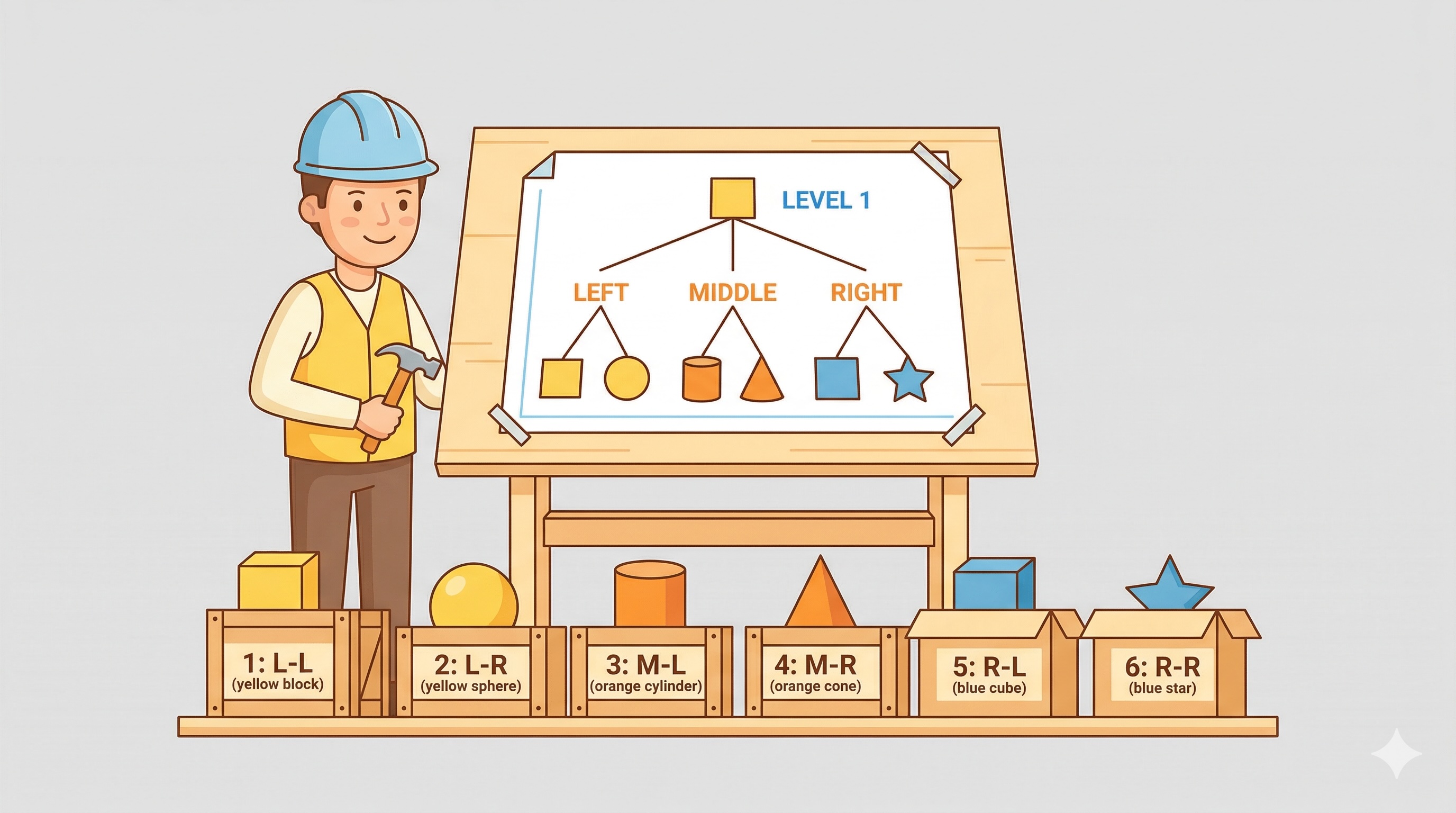
Imagine you are a master builder. You receive two documents in the mail: a blueprint and an inventory list. Your job is to reconstruct an entire building from these two pieces of paper. That is exactly what tree construction from traversals feels like.
In computer science, a binary tree is a structure where each node has up to two children: a left child and a right child. Think of it like a family tree, an org chart, or the folders on your computer. Trees are everywhere in software. But here is the interesting question: if someone hands you the raw data from a tree, can you rebuild it?
Preorder traversal visits nodes in this order: root first, then left subtree, then right subtree. Think of it as reading the blueprint from the top down. The very first thing the blueprint tells you is where the foundation goes. In preorder, the first element is always the root of the entire tree.
For a tree with root 3, left child
9, and right child
20, the preorder would be
[3, 9, 20, ...]. The blueprint
says: "Start with 3, then go left, then go right."
The blueprint tells you what to build and in what order, but it does not tell you where one subtree ends and another begins. For that, you need the inventory.
Inorder traversal visits nodes in this order: left subtree first, then root, then right subtree. Think of it as a sorted inventory list laid out from left to right across the building floor.
When you know the root (from preorder), you can scan the inventory list. Everything to the left of the root in the inventory belongs in the left subtree. Everything to the right belongs in the right subtree. This is the magic that makes reconstruction possible.
Together, preorder tells you "what to build first" and inorder tells you "what goes on each side." Neither list alone is enough, but together they uniquely define the tree.
Let us walk through a concrete example. Suppose you receive:
[3, 9, 20, 15, 7][9, 3, 15, 20, 7]Step 1: Find the foundation.
The first element of preorder is 3.
That is the root, the foundation of our building.
Step 2: Split the inventory.
Look at the inorder list. Find 3.
Everything to its left is [9] —
that is the left wing. Everything to its right is [15, 20, 7]
— that is the right wing.
Step 3: Repeat for each wing.
For the left wing, the next element in preorder is 9.
In the inorder for just that wing, [9],
9 is alone — no children. For the right wing, the next preorder element is
20. In inorder
[15, 20, 7], 15 goes left and 7 goes right.
You have now reconstructed the entire tree: root 3, left child 9, right child 20 with children 15 and 7.
This is one of the most common questions beginners ask. The answer lies in what each traversal captures.
Ready for more?
This is just the beginning. You now understand the core idea: preorder gives you the root, inorder gives you the boundaries. But how do we turn this into actual code? In Level 2, we will implement this step by step with real code in Python, Java, and C++.
Level 1
Learn how binary trees can be reconstructed from traversals using a building blueprint analogy.
Author
Mr. Oz
Duration
5 mins
Level 2
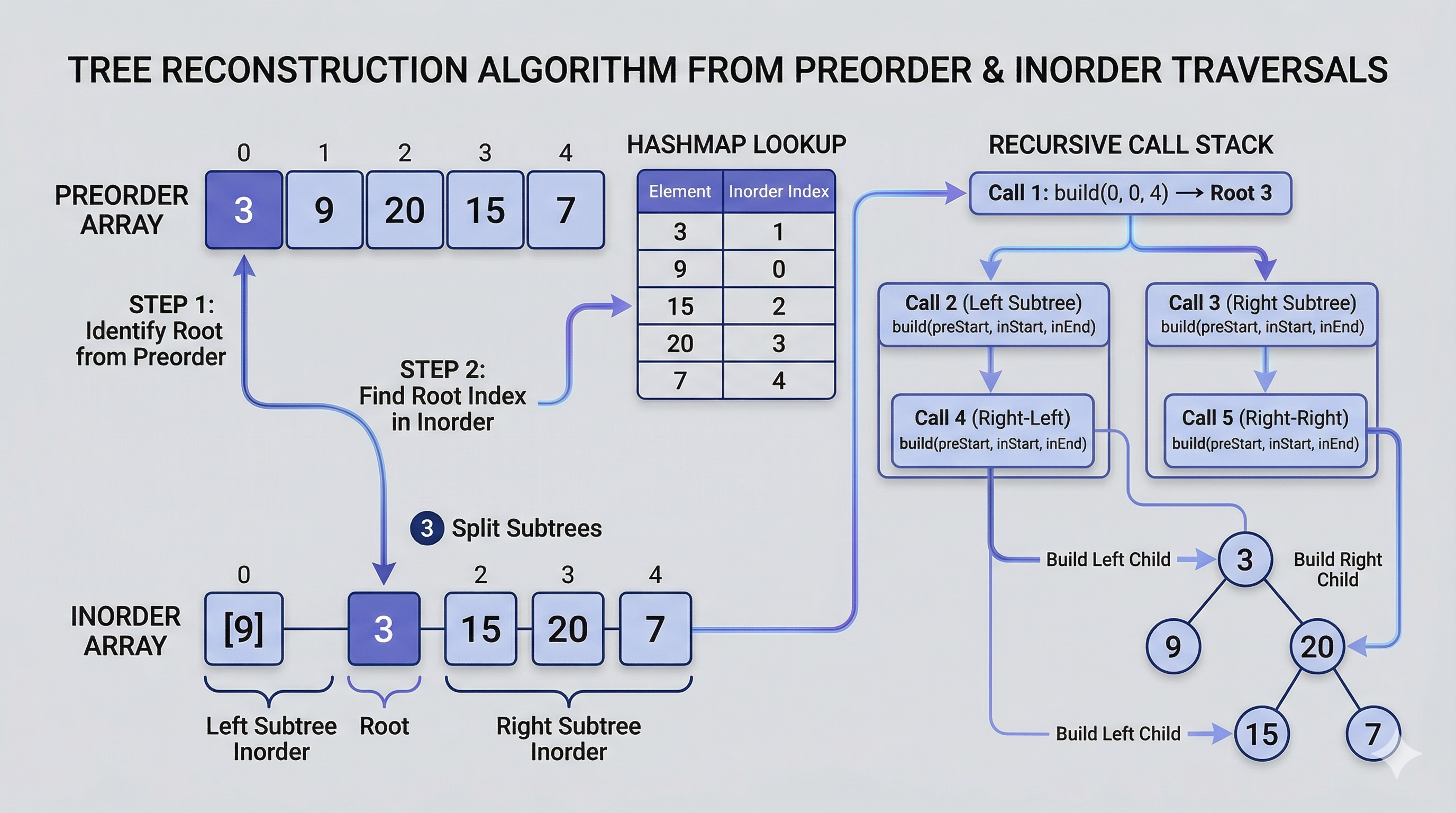
Step-by-step code implementation in Python, Java, and C++ with hashmap optimization and common pitfalls.
Author
Mr. Oz
Duration
8 mins
Level 3

Memory layout, CPU cache, iterative construction, and real-world use cases in compilers and parsers.
Author
Mr. Oz
Duration
12 mins