Understanding BST Properties: Implementation Guide
Implement BST operations from scratch. Inorder traversal, kth smallest with iterative stacks, and production-ready code in Python, Java, and C++.
Implement BST operations from scratch. Inorder traversal, kth smallest with iterative stacks, and production-ready code in Python, Java, and C++.
Author
Mr. Oz
Date
Read
8 mins
Level 2
Author
Mr. Oz
Date
Read
8 mins
Share


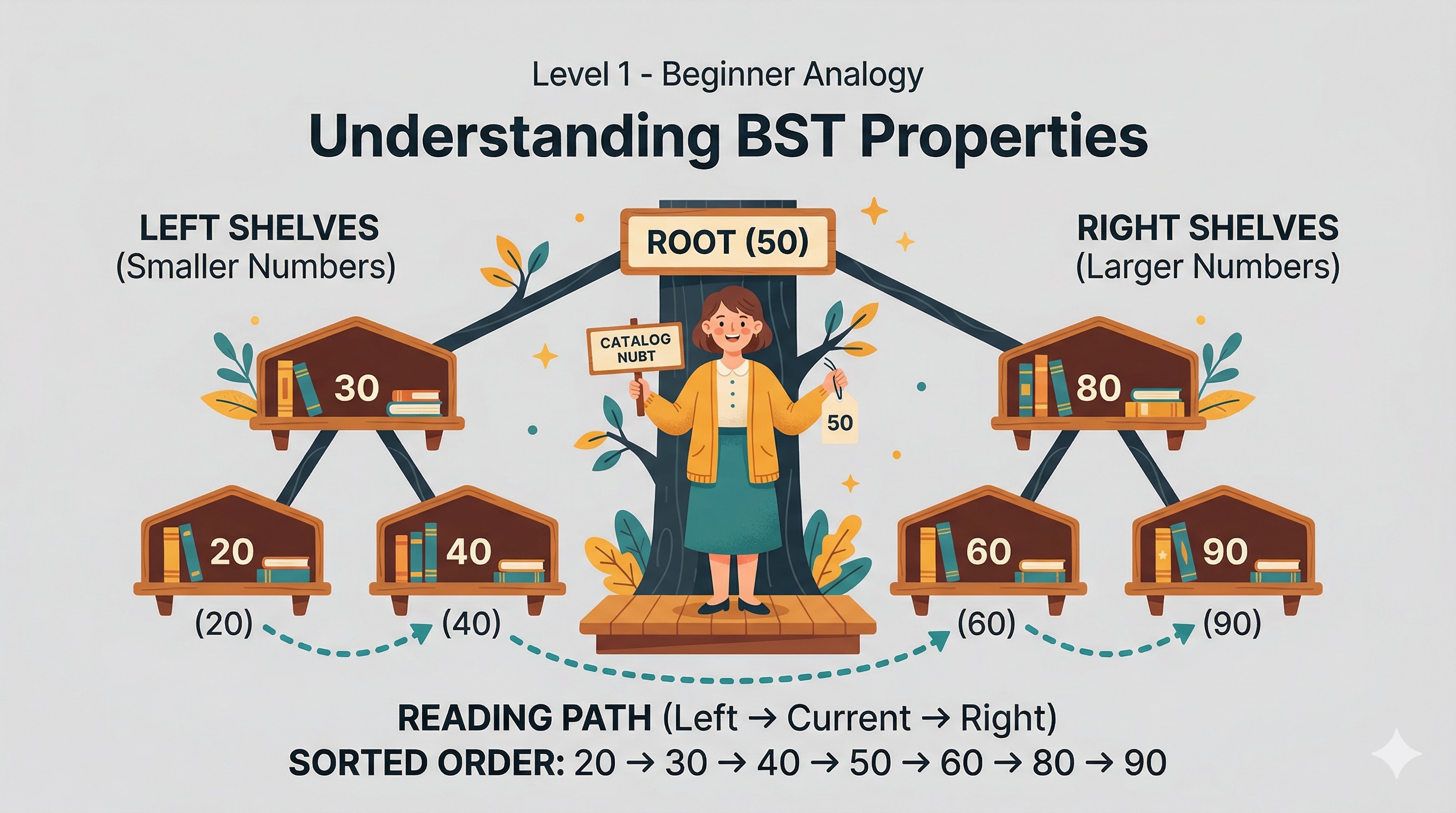
In Level 1, we explored the BST as a magical library catalog. Now it is time to build that library yourself. This guide covers inorder traversal, finding the kth smallest element, and all fundamental BST operations with working code.
Every BST is built from nodes. Each node stores a value and has two pointers: one to the left child and one to the right child.
class TreeNode:
    def __init__(self, val=0, left=None, right=None):
        self.val = val
        self.left = left
        self.right = right
Each TreeNode holds its value
and two optional children. A leaf node simply has None for both children.
class TreeNode {
    int val;
    TreeNode left;
    TreeNode right;

    TreeNode(int val) {
        this.val = val;
        this.left = null;
        this.right = null;
    }
}struct TreeNode {
int val;
TreeNode* left;
TreeNode* right;
TreeNode(int x) : val(x), left(nullptr), right(nullptr) {}
};Inorder traversal visits nodes in the order: left subtree, current node, right subtree. For a BST, this produces elements in ascending sorted order.
def inorder(root):
    result = []
    def traverse(node):
        if not node:
            return
        traverse(node.left)       # Visit left subtree first
        result.append(node.val)   # Then current node
        traverse(node.right)      # Then right subtree
    traverse(root)
    return result
Time: O(n) — visits every node once. Space: O(h) for the call stack, where h is the tree height (O(log n) balanced, O(n) worst case).
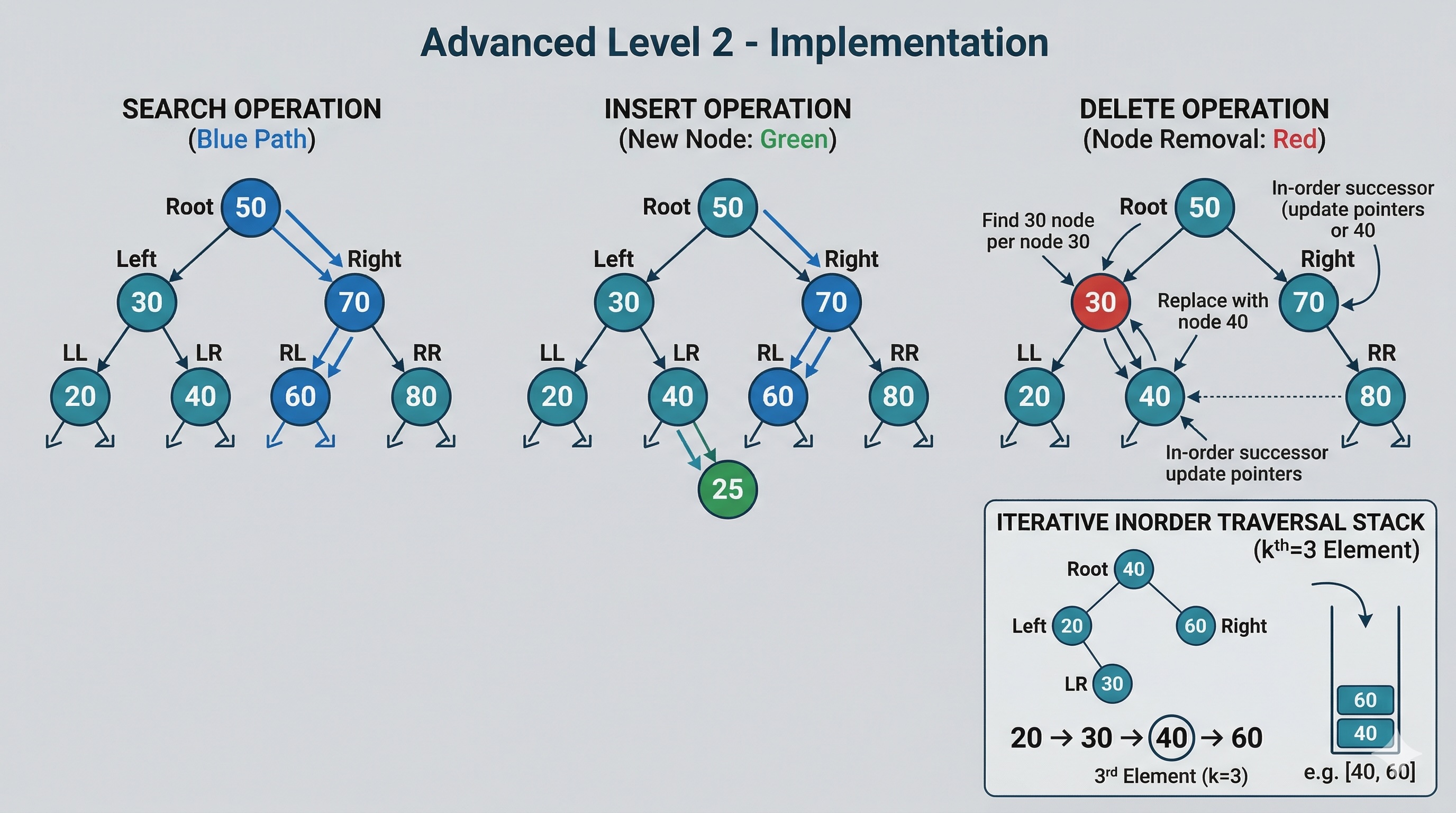
Since inorder gives sorted output, the kth smallest is simply the kth element in inorder sequence. But we can do better than generating the full list — use an iterative stack and stop early.
def kth_smallest(root, k):
    stack = []
    node = root
    count = 0

    while stack or node:
        while node:
            stack.append(node)    # Push all left descendants
            node = node.left
        node = stack.pop()        # Process the smallest unvisited
        count += 1
        if count == k:            # Found the kth element
            return node.val
        node = node.right         # Move to right subtree

    return None  # k is out of bounds
The inner while node loop
pushes the leftmost path onto the stack. Then we pop the smallest, count it, and if it matches k,
we return immediately. This avoids visiting the entire tree.
Time: O(k) in the best case (stops early). Space: O(h) for the stack.
public int kthSmallest(TreeNode root, int k) {
    Deque<TreeNode> stack = new ArrayDeque<>();
    TreeNode node = root;
    int count = 0;

    while (!stack.isEmpty() || node != null) {
        while (node != null) {
            stack.push(node);
            node = node.left;
        }
        node = stack.pop();
        count++;
        if (count == k) return node.val;
        node = node.right;
    }
    throw new IllegalArgumentException("k out of bounds");
}int kthSmallest(TreeNode* root, int k) {
stack<TreeNode*> stk;
TreeNode* node = root;
int count = 0;
while (!stk.empty() || node != nullptr) {
while (node != nullptr) {
stk.push(node);
node = node->left;
}
node = stk.top(); stk.pop();
count++;
if (count == k) return node->val;
node = node->right;
}
return -1;
}The iterative approach is O(k) time. For repeated kth smallest queries on a static tree, we can do better. Augment each node with its subtree size:
class AugNode:
    def __init__(self, val):
        self.val = val
        self.left = None
        self.right = None
        self.size = 1  # Includes this node

def update_size(node):
    if node:
        left_size = node.left.size if node.left else 0
        right_size = node.right.size if node.right else 0
        node.size = 1 + left_size + right_size
Now, at each node, if left_size + 1 == k,
the current node is the answer. If k is smaller, go left. If k is larger, go right with
k -= (left_size + 1).
This gives O(log n) per query on a balanced tree.
def search(root, target):
    node = root
    while node:
        if target == node.val:
            return node
        elif target < node.val:
            node = node.left
        else:
            node = node.right
    return None
Start at root. Go left if target is smaller, right if larger. Repeat until found or null is reached.
def insert(root, val):
    if not root:
        return TreeNode(val)
    if val < root.val:
        root.left = insert(root.left, val)
    elif val > root.val:
        root.right = insert(root.right, val)
    return root
Navigate to the correct leaf position and create the node. Returns the (possibly new) root.
def find_min(root):
    if not root: return None
    while root.left:
        root = root.left
    return root.val

def find_max(root):
    if not root: return None
    while root.right:
        root = root.right
    return root.val
Minimum is always the leftmost node. Maximum is always the rightmost node.
Deleting a node has three cases:
def delete(root, val):
    if not root:
        return None
    if val < root.val:
        root.left = delete(root.left, val)
    elif val > root.val:
        root.right = delete(root.right, val)
    else:
        if not root.left:
            return root.right
        if not root.right:
            return root.left
        successor = find_min_node(root.right)
        root.val = successor.val
        root.right = delete(root.right, successor.val)
return root| Operation | Balanced | Worst Case |
|---|---|---|
| Search | O(log n) | O(n) |
| Insert | O(log n) | O(n) |
| Delete | O(log n) | O(n) |
| Inorder Traversal | O(n) | O(n) |
| Kth Smallest (iterative) | O(k) | O(n) |
| Kth Smallest (augmented) | O(log n) | O(n) |
Remember that k is 1-indexed: k=1 means the smallest element, k=2 means the second smallest.
If you use a 0-indexed counter internally, adjust accordingly: return when count == k
if your counter starts at 0 and increments before checking.
If elements are inserted in sorted or nearly sorted order, the BST degrades to a linked list. All operations drop to O(n). In production, use self-balancing BSTs (AVL, Red-Black) or shuffle input before insertion when possible.
In Java and C++, be cautious with integer operations on node values during subtree size calculations
or comparisons. Use long in Java
or long long in C++ if there is any risk of overflow.
Ready for more?
Level 1
Discover how Binary Search Trees organize data like a magical library where every shelf follows a perfect rule.
Author
Mr. Oz
Duration
5 mins
Level 2
Inorder traversal, kth smallest with iterative stacks, and full BST operations in Python, Java, and C++.
Author
Mr. Oz
Duration
8 mins
Level 3

Memory layout, cache performance, self-balancing trees, and real-world use cases in production systems.
Author
Mr. Oz
Duration
12 mins