Understanding Binary Search Trees — Level 2
Implementation deep dive: master BST operations including insertion, search, deletion, and tree traversals with production-ready code patterns.
Implementation deep dive: master BST operations including insertion, search, deletion, and tree traversals with production-ready code patterns.
Author
Mr. Oz
Date
Read
8 mins
Level 2
Author
Mr. Oz
Date
Read
8 mins
Share


In Level 1, we understood what BSTs are. Now let's implement them. We'll cover the core operations that make BSTs useful in real applications.
Every BST node needs three things: a value and two child pointers.
# Python
class TreeNode:
def __init__(self, val=0, left=None, right=None):
self.val = val
self.left = left
self.right = right
// Java
class TreeNode {
int val;
TreeNode left;
TreeNode right;
TreeNode(int val) { this.val = val; }
}
// C++
struct TreeNode {
int val;
TreeNode *left;
TreeNode *right;
TreeNode(int x) : val(x), left(nullptr), right(nullptr) {}
};
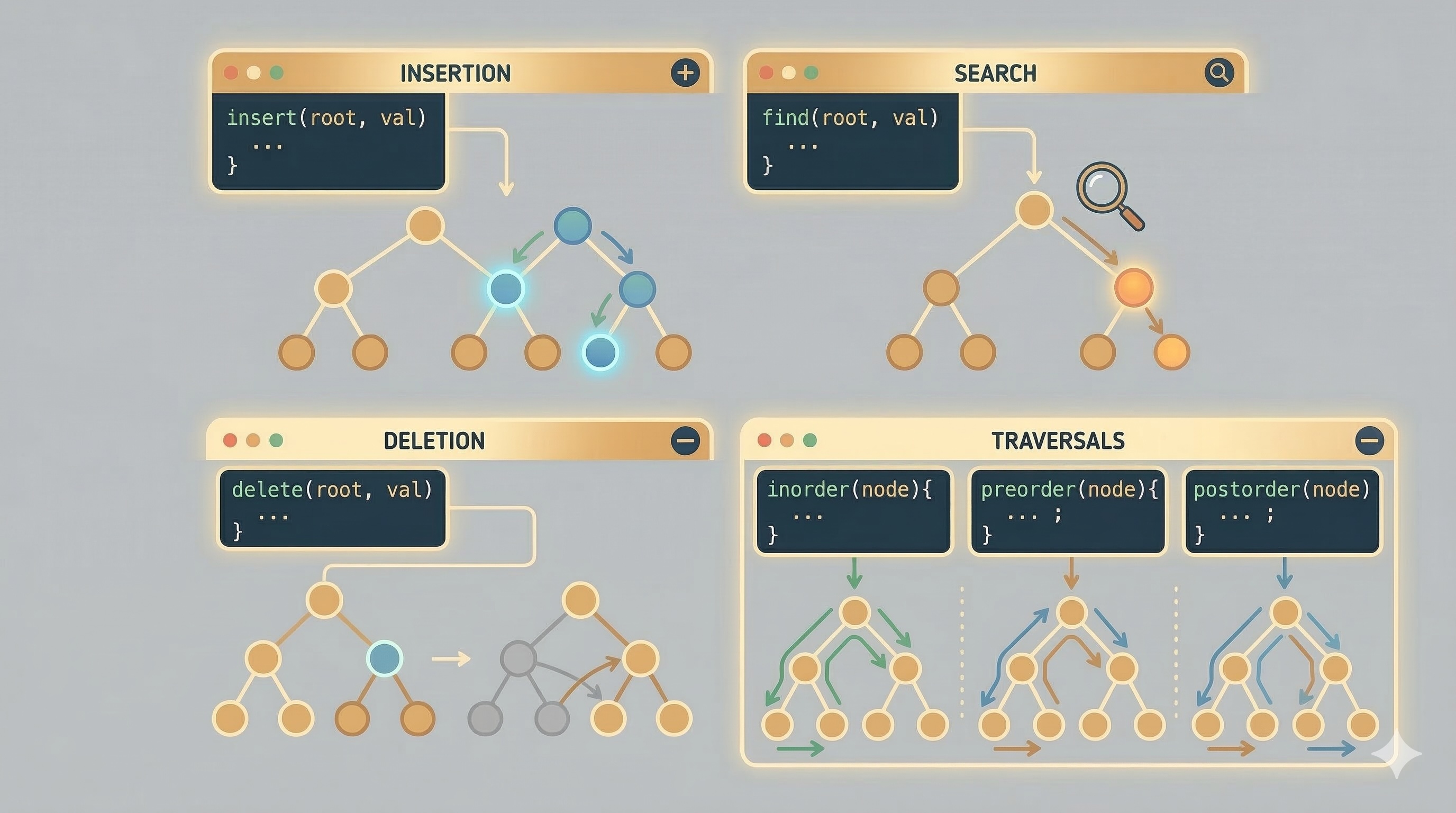
Searching is the fundamental BST operation. Compare and go left or right.
# Python
def search(root, target):
if not root or root.val == target:
return root
if target < root.val:
return search(root.left, target)
return search(root.right, target)
Time: O(log n) balanced, O(n) worst case | Space: O(log n) recursion stack
Insertion follows the same path as search, but we create a new node when we hit a null.
# Python
def insert(root, val):
if not root:
return TreeNode(val)
if val < root.val:
root.left = insert(root.left, val)
else:
root.right = insert(root.right, val)
return root
// Java
public TreeNode insert(TreeNode root, int val) {
if (root == null) return new TreeNode(val);
if (val < root.val)
root.left = insert(root.left, val);
else
root.right = insert(root.right, val);
return root;
}
Note: Equal values typically go to the right subtree (or left, depending on implementation choice). Be consistent!
Deletion has three cases based on how many children the node has:
# Python
def delete(root, key):
if not root:
return None
if key < root.val:
root.left = delete(root.left, key)
elif key > root.val:
root.right = delete(root.right, key)
else: # Found the node to delete
if not root.left:
return root.right
if not root.right:
return root.left
# Two children: find inorder successor
succ = find_min(root.right)
root.val = succ.val
root.right = delete(root.right, succ.val)
return root
# Helper: find minimum node
def find_min(node):
while node.left:
node = node.left
return node
Four main traversal patterns — each serves different purposes:
Returns sorted values in a BST!
def inorder(root):
if root:
inorder(root.left)
print(root.val)
inorder(root.right)
Useful for copying/serializing trees
def preorder(root):
if root:
print(root.val)
preorder(root.left)
preorder(root.right)
Useful for deleting/calculation trees
def postorder(root):
if root:
postorder(root.left)
postorder(root.right)
print(root.val)
Visit nodes level by level
from collections import deque
def levelorder(root):
if not root: return
q = deque([root])
while q:
node = q.popleft()
print(node.val)
if node.left: q.append(node.left)
if node.right: q.append(node.right)
| Operation | Average | Worst |
|---|---|---|
| Search | O(log n) |
O(n) |
| Insert | O(log n) |
O(n) |
| Delete | O(log n) |
O(n) |
| Traversal | O(n) |
O(n) |
Worst case occurs when the tree becomes a linked list (completely unbalanced).
Level 1

Learn the fundamentals of BSTs through an engaging magical library analogy.
Author
Mr. Oz
Duration
5 mins
Level 2
Implementation details, insertion, search, deletion, and traversal operations.
Author
Mr. Oz
Duration
8 mins
Level 3
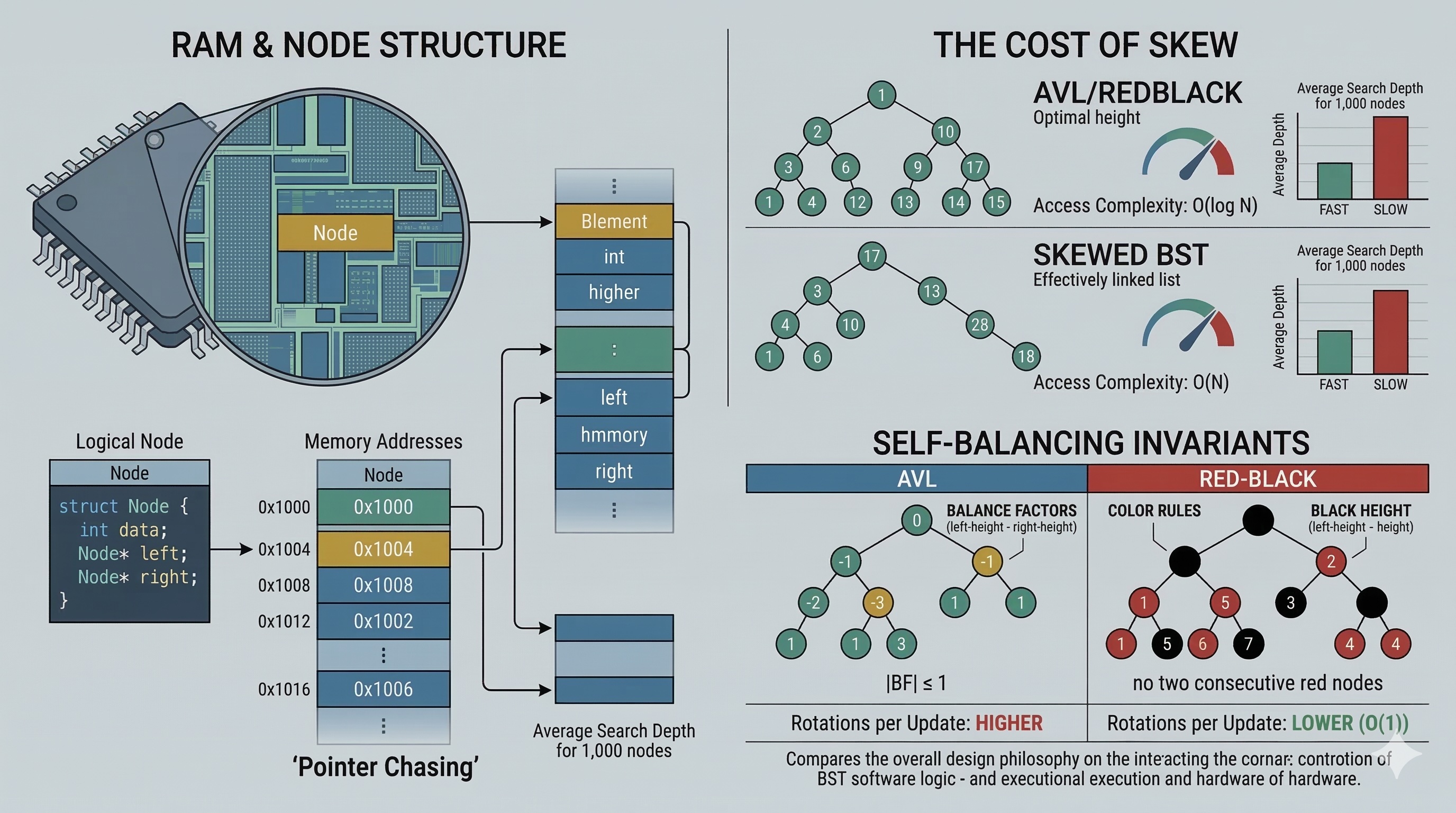
Balancing techniques, AVL trees, Red-Black trees, and performance optimization.
Author
Mr. Oz
Duration
12 mins