Understanding BFS vs DFS: The Maze Explorers
Learn the fundamental difference between breadth-first and depth-first search through an engaging maze exploration analogy. Discover when to use each strategy for optimal results.
Learn the fundamental difference between breadth-first and depth-first search through an engaging maze exploration analogy. Discover when to use each strategy for optimal results.
Author
Mr. Oz
Date
Read
5 mins
Level 1
Author
Mr. Oz
Date
Read
5 mins
Share


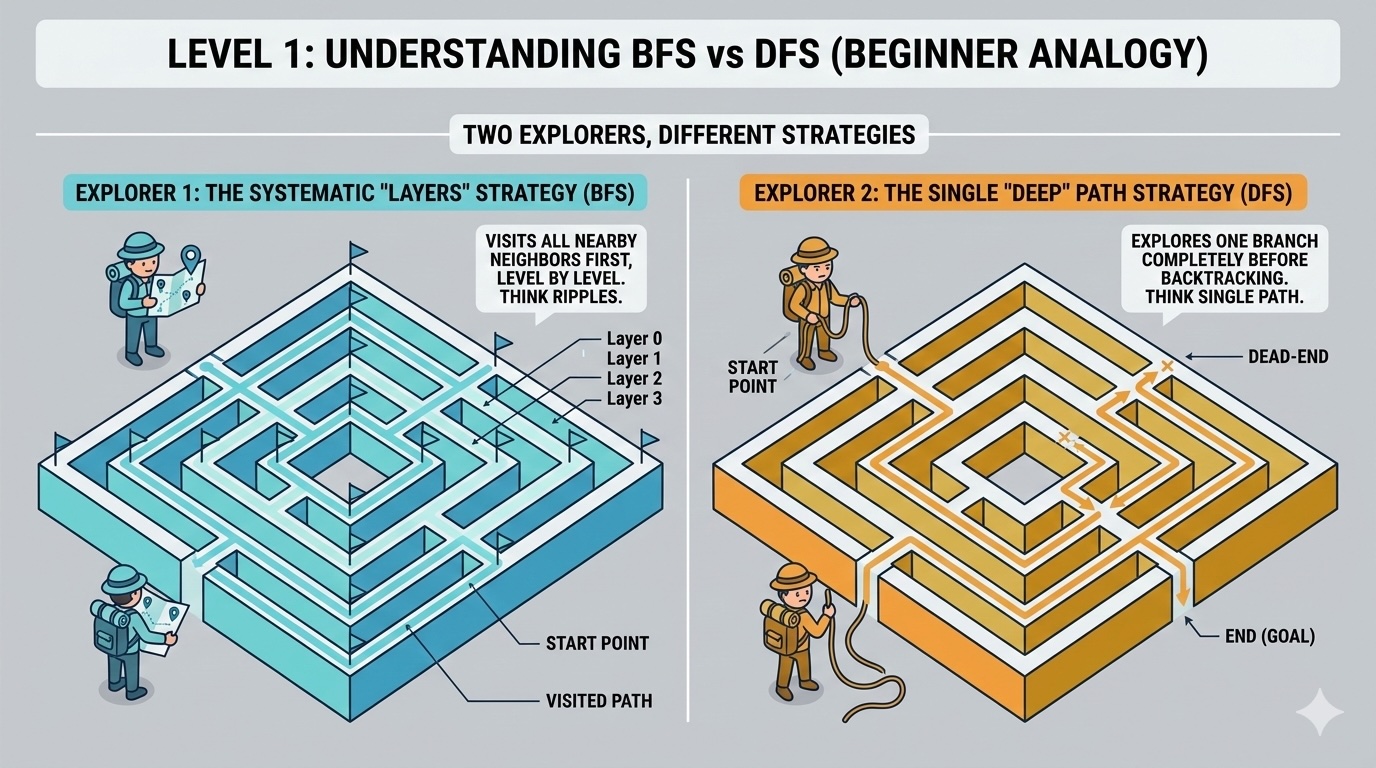
Imagine you're trapped in a giant maze and need to find the exit. You have two friends with very different exploration strategies: Betty the Breadth-First Explorer and Derek the Depth-First Diver.
Both will find the exit eventually, but their approaches are fundamentally different—and understanding this difference is key to mastering tree and graph traversal.
Betty is methodical. She says: "I'll explore all paths at distance 1 first, then all paths at distance 2, then distance 3, and so on."
Betty's advantage: If the exit is nearby, she'll find it first! She's guaranteed to find the shortest path to any destination.
Derek is adventurous. He says: "I'll pick a path and go as deep as possible until I hit a dead end. Then I'll backtrack and try another path."
Derek's advantage: He uses less memory (only remembers one path at a time) and can be faster for finding any path (not necessarily the shortest).
Imagine a tree structure representing possible paths:
                    A
                  / | \
                 B  C  D
                /|     |
               E F     G
              BFS order: A → B, C, D → E, F, G  (level by level)
              DFS order: A → B → E → F → C → D → G  (deep first, then backtrack)
BFS explores "wide" (siblings before children), while DFS explores "deep" (children before siblings).
Minimum Depth of Binary Tree: To find the shortest path to a leaf, use BFS! As soon as you encounter a leaf, you know it's the minimum depth. DFS would need to explore all paths to find the minimum.
Ready for more?
Level 1
Learn BFS vs DFS through a maze exploration analogy. Discover when to use each strategy.
Author
Mr. Oz
Duration
5 mins
Level 2
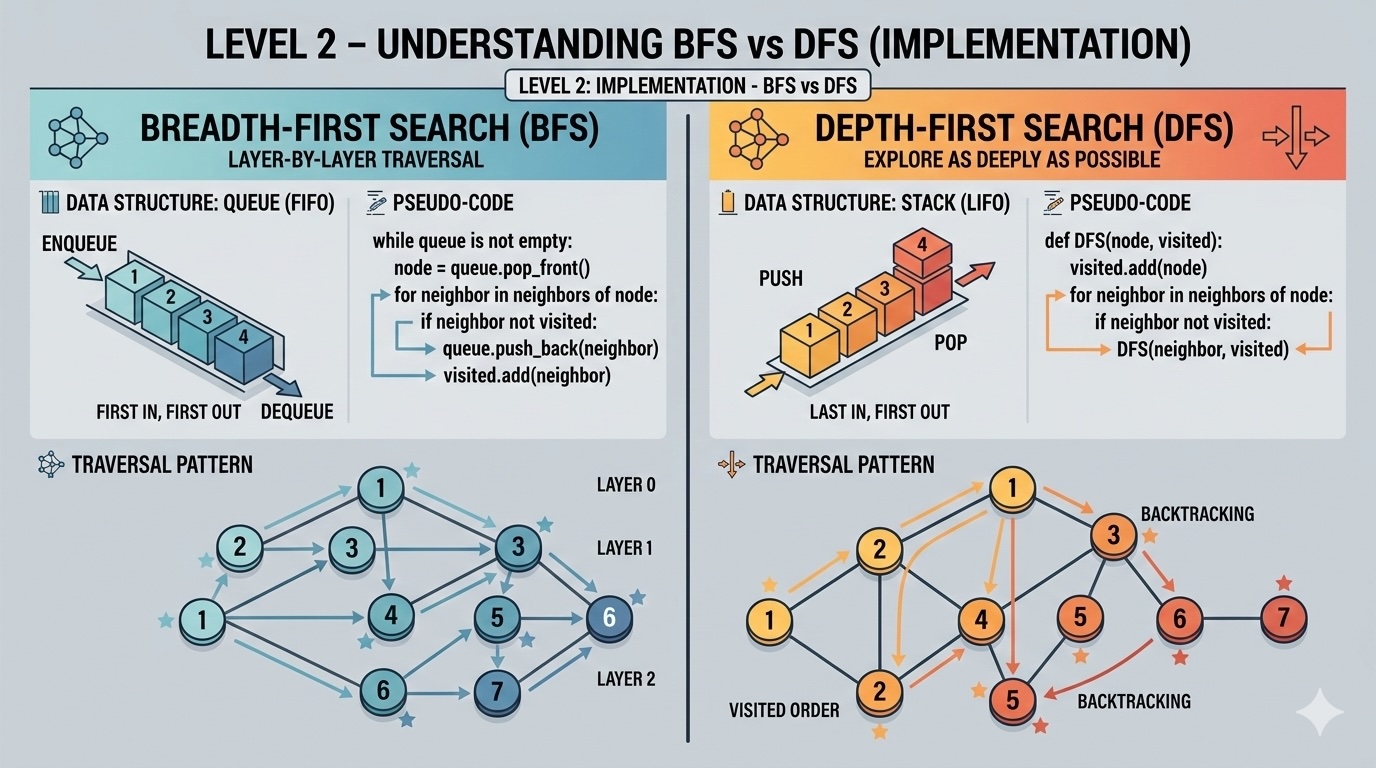
Implementation details, queue vs stack usage, and production-ready code examples.
Author
Mr. Oz
Duration
8 mins
Level 3
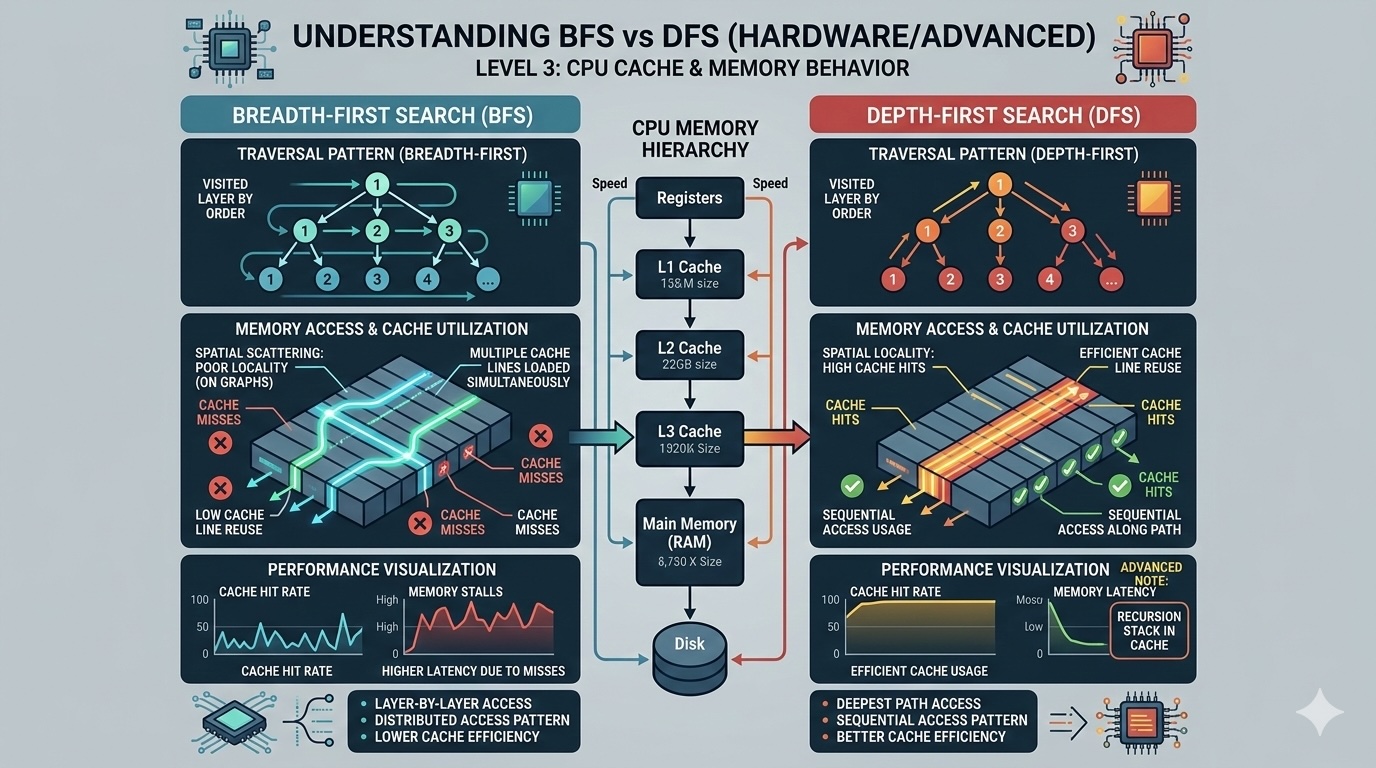
Memory layout, CPU cache performance, and real-world optimization techniques.
Author
Mr. Oz
Duration
12 mins