Understanding Merge Algorithms: Implementation Guide
Dive into the technical implementation of merge algorithms. Learn the dummy node pattern, pointer manipulation, and common pitfalls to avoid.
Dive into the technical implementation of merge algorithms. Learn the dummy node pattern, pointer manipulation, and common pitfalls to avoid.
Author
Mr. Oz
Date
Read
8 mins
Level 2
Author
Mr. Oz
Date
Read
8 mins
Level
2
When implementing merge algorithms for linked lists, the dummy node pattern is a professional technique that simplifies edge cases. Instead of treating the first node as special, we create a dummy node that serves as the starting point of our merged list.
dummy = ListNode(0)
current = dummy
This eliminates the need for special handling when the merged list is empty or when choosing which list's first node becomes the merged list's head. We always return dummy.next at the end.
def mergeTwoLists(list1, list2):
    dummy = ListNode(0)  # Dummy node to simplify edge cases
    current = dummy

    while list1 and list2:
        if list1.val < list2.val:
            current.next = list1
            list1 = list1.next
        else:
            current.next = list2
            list2 = list2.next
        current = current.next

    # Attach remaining nodes
    current.next = list1 if list1 else list2

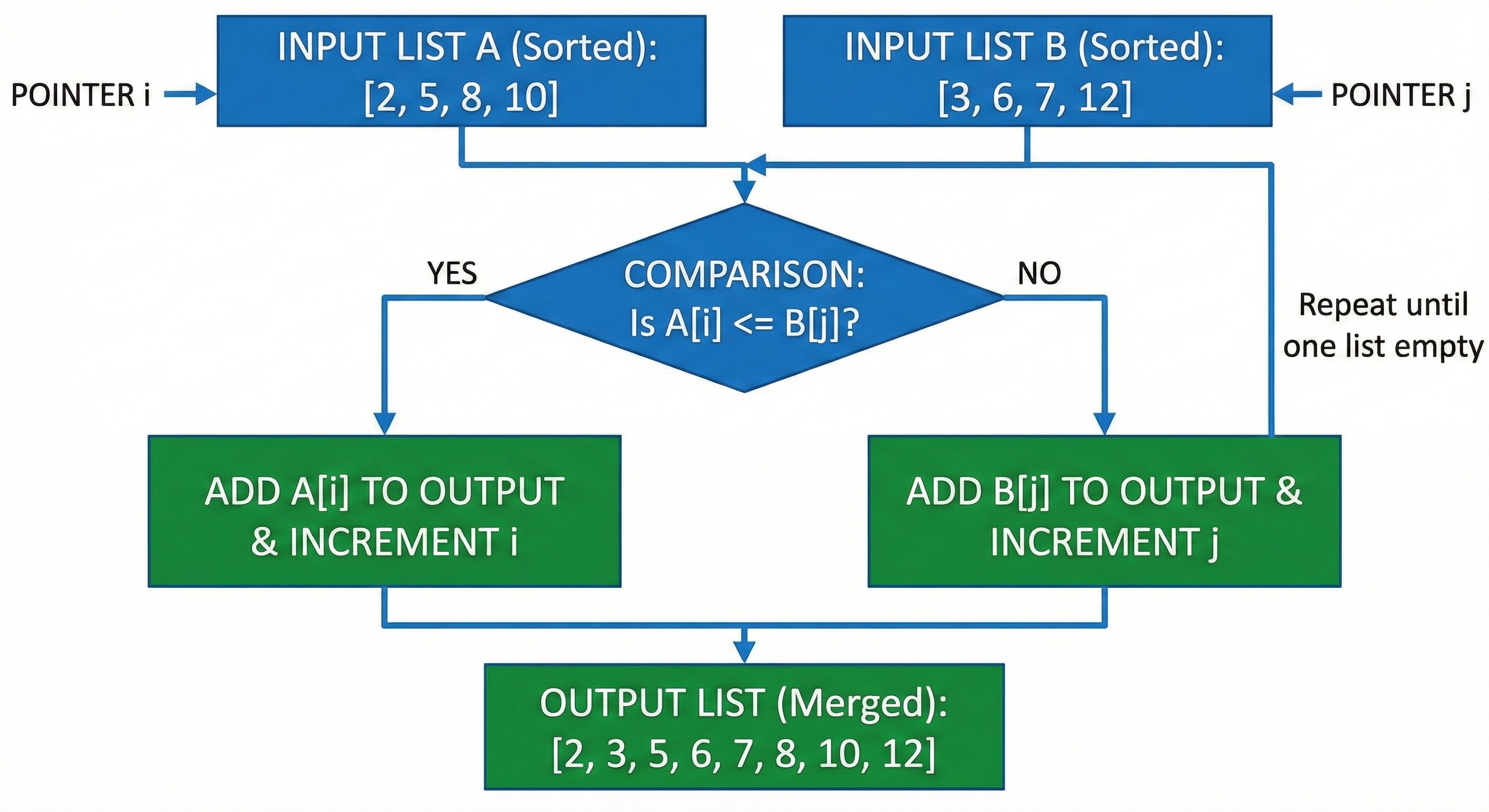
return dummy.nextFor arrays, the approach is similar but we use indices instead of pointers:
def merge_arrays(arr1, arr2):
    result = []
    i = j = 0

    while i < len(arr1) and j < len(arr2):
        if arr1[i] <= arr2[j]:
            result.append(arr1[i])
            i += 1
        else:
            result.append(arr2[j])
            j += 1

    # Add remaining elements
    result.extend(arr1[i:])
    result.extend(arr2[j:])

return result| Operation | Time Complexity | Space Complexity |
|---|---|---|
| Merge two sorted lists/arrays | O(n + m) | O(1) for lists, O(n + m) for arrays |
| Access current node | O(1) | O(1) |
| Append to result | O(1) | O(1) |
The dummy node is a type of sentinel—a value that doesn't hold real data but marks boundaries. Sentinels are widely used in computer science to simplify boundary conditions.
When memory is constrained, you might need to merge in-place. This is trickier for linked lists but straightforward for arrays with enough buffer space.
⚠️ Forgetting to Advance the Current Pointer
After attaching a node, always move the current pointer: current = current.next. Without this, you'll keep overwriting the same position.
💡 Modifying Original Lists
The merge algorithm modifies the next pointers of the original nodes. If you need to preserve the original lists, make copies first.
✓ Not Handling Remainder
Always attach the remaining nodes after the main loop: current.next = list1 or list2. Don't assume both lists are exhausted simultaneously.
current is clearer than p or ptrNow that you understand the implementation, let's explore the hardware-level optimizations and real-world performance considerations in Level 3.