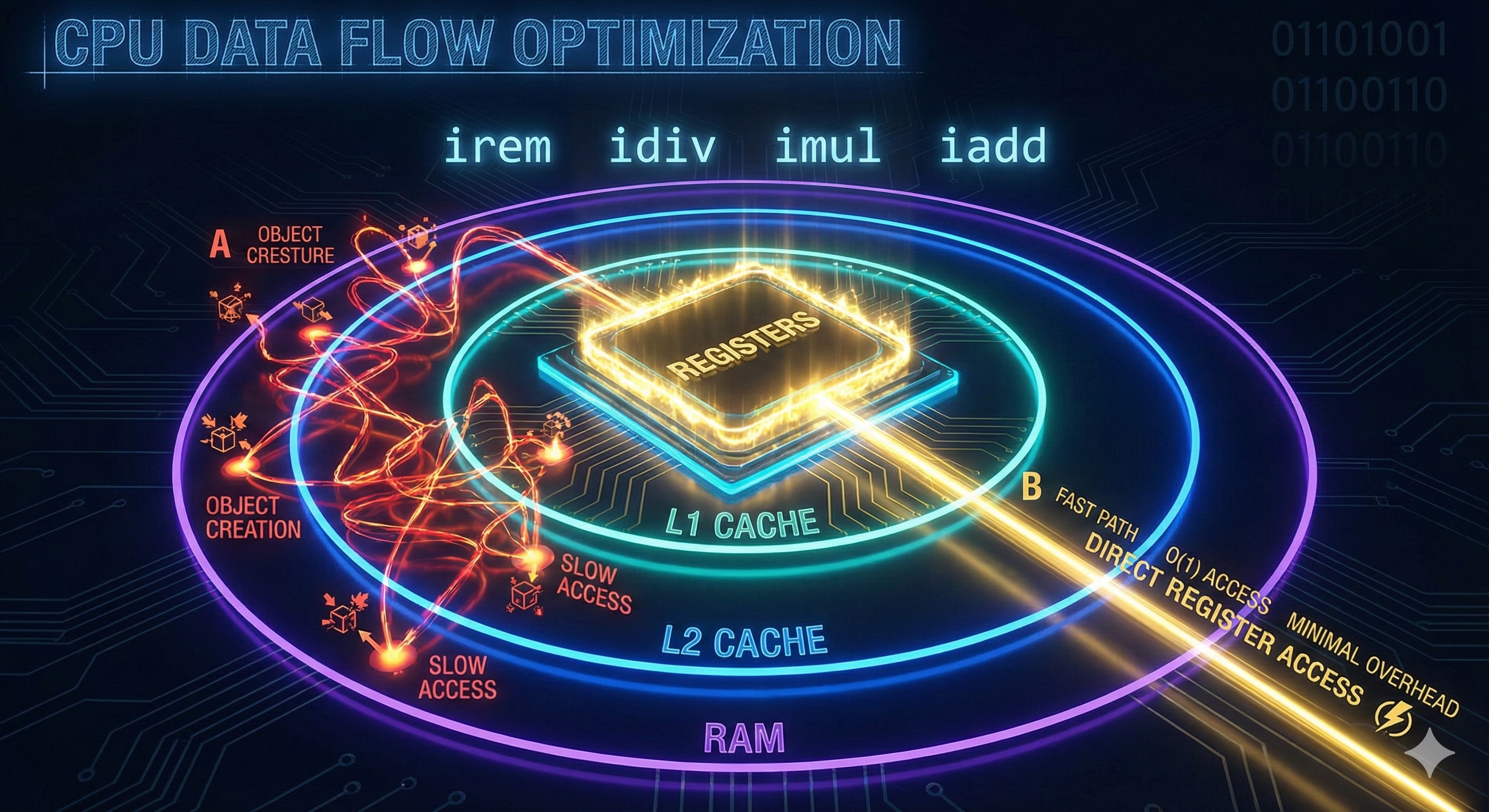
To understand why the mathematical approach is superior, we have to look at the
CPU and JVM internals. This is where theory meets silicon.
-
The Cost of Division vs. Branching
In our code, we use x % 10 and
x / 10.
Historically, division is one of the "slowest" instructions on a CPU compared to addition or bit-shifting.
However, modern compilers and JIT (Just-In-Time) optimization are incredibly smart.
When you divide by a constant (like 10), the compiler often replaces the DIV instruction
with a "Reciprocal Multiplication."
How it works: Instead of dividing, the CPU multiplies by a specific "magic number" and then shifts the bits.
This is significantly faster than a standard division instruction.
-
CPU Cache and Locality
When you use the mathematical approach, all your data fits in CPU Registers.
Registers are the fastest storage in the computer (sub-nanosecond access).
| Storage Level |
Access Time |
Used By |
| CPU Registers |
~0.5 ns |
Math approach |
| L1 Cache |
~1-2 ns |
Small objects |
| L2 Cache |
~4-7 ns |
Medium objects |
| Main RAM |
~100 ns |
String approach |
When you convert to a String, the data moves to the L1/L2 Cache or even the Main RAM.
Accessing RAM can be 100x to 200x slower than accessing a register.
By staying in "Math land," you keep the data as close to the "brain" of the computer as possible.
-
Branch Prediction
The while (x > revertedNumber) loop is very "predictable"
for a CPU's branch predictor.
The CPU guesses that the loop will continue and starts pre-fetching the next instructions.
Because the logic is simple and doesn't involve complex object lookups, the "pipeline" stays full.
Why this matters: Modern CPUs execute instructions in a pipeline. A mispredicted branch
can cause a "pipeline flush" — throwing away 10-20 cycles of work. Simple, predictable loops avoid this penalty.
-
Immutability and Bytecode
If you look at the Java Bytecode (javap -c),
the String approach involves many expensive operations:
// String approach bytecode (simplified)
invokestatic  Integer.toString    // Create string from int
new           StringBuilder       // Allocate new object
invokespecial <init>              // Constructor call
invokevirtual reverse             // Method dispatch
invokevirtual toString            // Another allocation
invokevirtual equals              // Comparison
Our mathematical approach translates to simple, fast instructions:
// Math approach bytecode (simplified)
irem    // Integer remainder (x % 10)
idiv    // Integer division (x / 10)
imul    // Integer multiplication (* 10)
iadd    // Integer addition
These are the bread and butter of the JVM. They require no method dispatch overhead
and can be easily inlined by the JIT compiler.
-
The Data Path Visualization
Think of it this way:
String Approach Path
Integer → Heap (String) → Array (char[]) →
Heap (StringBuilder) → Array (char[]) →
Heap (new String) → Comparison
Multiple memory allocations, cache misses likely
Math Approach Path
Register → Register → Register → Comparison
All in registers, zero allocations